


Stop asking, “Am I a good writer?” Ask, “What am I good at, and what writing skills do I need to practice?”
If you’d like to receive my blog in your in-box each week, click here.
I know it might not look like it from this picture, but I’ve always thought my dog, Gavin, is pretty smart.
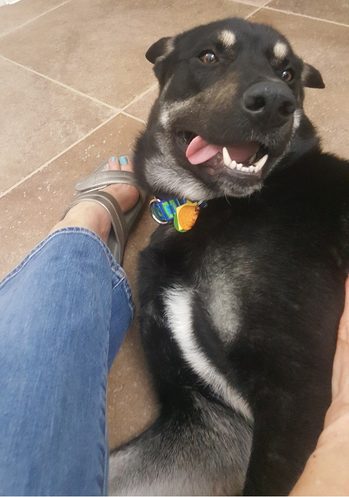
He loves learning and is very quick to do it. When I or our trainer teaches him something new, I can watch the wheels turning in his mind as he swiftly figures out what we’re asking, and he’s extremely food-motivated (lucky for us! It always makes a dog much easier to train), so he works hard to give us what we want and get his reward.
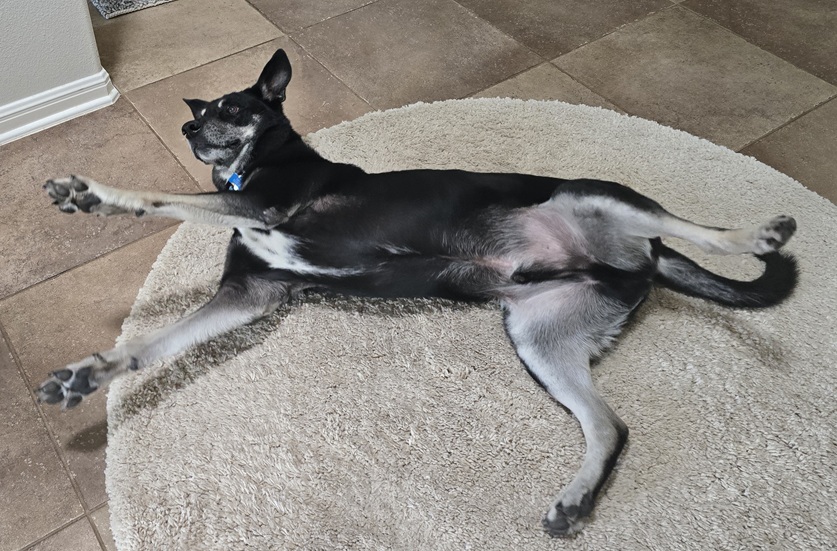
But lately we’ve been working on a new adjustment to an old skill in his repertoire: Play dead. (We like the classics.) Gavin’s “dead” has always been his own thing: He leans gradually over from lying down until he’s on his side, head off the ground and feet stiff in the air like a dead bug, and then scrambles right back up.
I’ve let it go for years. It’s close enough, and while most of the “tricks” I teach him have a greater purpose—like “Get on your spot” to keep him from mugging us when we’re putting his food down or “Come back!” to ensure we can recall him when it’s important—this one is pure theater.
But lately, especially given the maliciously hot Austin temperatures, I’ve been looking for ways to occupy and stimulate him indoors, so we’ve been working on honing his “dead” into something a little cleaner.
You guys, this dog will not get it. His dead is less like this one, where the dog drops immediately into it, and more like a slow-motion replay or a hammy actor’s drawn-out death scene. He’s less “I’ve been shot!” and more “I’m slowly wasting away.”
Eventually he gets frustrated when he’s not getting rewarded for what always got him rewarded before and then he just starts maniacally running through his repertoire: sit, wave, down, roll over, twirl, “peekaboo” (a very cute trick where he comes behind me and pops his head out between my legs), etc., as if someone pressed fast-forward.
What the hell happened to my “smart” dog?
What Constitutes “Smart”?
We may be misclassifying intelligence in animals, according to this recent New York Times article. In the 1990s psychologist Stanley Coren created a ranking list for canine intelligence by breed—you may be familiar with it, topped by the much-vaunted border collie, and with poor (and apparently dim) Afghan hounds bringing up the rear.
Not far from the bottom, in position 64, is the Great Pyrenees—and longtime readers may remember that not long ago we lost ours, Alex.
True to his ranking—and entirely unlike Gavin—Alex was manifestly uninterested in obedience training. He could be induced to perform the basics, but for the most part he would sit (or lie down, or whatever he was in the mood for) and gaze at us with those adorable big brown eyes and his good-natured Pyrenees smile and simply wait patiently for us to give him the treat.
Maybe Stanley Coren would rank him as a dum-dum, but look at it from Alex’s point of view: He watched silly Gavin perform like a circus monkey to get what Alex had trained his humans to give him on his own terms.
Who’s the dummy now?
No Writer Is Good at Everything
That’s basically the premise of the NYT article, which summarizes the author’s visit to the Duke Canine Cognition Center. Such assessments are subjective both in how we define what makes someone “smart” and in who is doing the defining: “[I]nterpretation is everything…. Someone deemed clever in one manner or setting can be clueless in others.”
And yet all too frequently I work with authors who get frustrated when struggling in a certain area of their story, or because no matter how many stories they write they feel they just can’t seem to master a particular element of storytelling. “I know I’m great at characterization but I can’t seem to figure out how to let readers into their inner life”; “My plots are rock-solid, but my characters are thin”; “I always start and end strong, but get lost in the mushy middle.”
They utter these proclamations as if they’re the ultimate verdict on their writing or themselves as writers: They’re flawed or substandard or lack talent or skill because they’re not great at every aspect of storytelling craft.
But this kind of thinking is simplistic and overgeneralized: Being good at a particular thing isn’t a statement on anyone’s overall ability or intelligence. Most of us are good at some things and not so much at others. I can hold countless details and plot threads in my mind on stories of complex construction and many thousands of words and readily see ways to weave it all together effectively…but ask me to fix something on my computer or phone or Kindle and I immediately call in-house IT (aka the hubs). I’m not stupid; that’s just not a skill that comes as easily to me as editing.
And like Coren’s list, these limiting views rely on a specific and subjective set of criteria and contexts. Both Gavin and Alex are smart—just in different areas and ways.
I doubt Dan Brown worries that his characters aren’t particularly fleshed out, and neither do his readers—that’s not what his twisty plot-driven treasure-hunt tales are about. Kevin Kwan probably doesn’t especially care if he’s head-hopping like a coked-up frog from paragraph to paragraph (and even line to line in some dizzyingly disorienting passages)—his fast-paced romantic family and social comedies do just fine with readers who love their lavish settings and over-the-top opulence.
Play to Your Writing Strengths
Assessments of writing talent or ability are also dependent on many other factors: What does the market deem “popular” or “good” or “salable” at the moment? What trends are motivating readers? What changes in the social and cultural zeitgeist or the state of the world may have a bearing on what stories seem to appeal at any given time and which don’t? How do different genres define what makes a story effective?
I recommend reading the whole NYT article—it’s not just fascinating for dog lovers, but an insightful repositioning of the way we define intelligence and skill. Gavin’s “dead” actually makes perfect sense if I look at it in fuller context: He is a guarding breed, highly alert and always ready to leap into defense mode. We work obedience in a particular spot in the foyer, with Gavin on a rug and me standing between him and the front door.
Asking my protective dog to deliberately put himself into a completely helpless position while I am directly in the line of fire of any threat that might come through that door probably makes no sense to him. By refusing to drop his guard—especially when I’m vulnerable—my dog may actually be questioning my own intelligence in demanding he do so.
Gavin knows what he’s good at. He does his best to give me what I want, but he’s not going to undermine his greatest talents.
And perhaps there’s a lesson to be gleaned here from our pets. As the article posits, performance according to subjective and varying standards may “reflect not raw brainpower but how well a certain trait or set of traits serves the particular mission at hand.” Sub out “talent” or “skill” or “ability” for “brainpower” as a writer and you may begin to realize that dogging yourself (sorry, it was right there) for your shortcomings is not only counterproductive, but meaningless. “How much of what we call intelligence is really proclivity for and mastery of a valued job?” the article rightly asks.
The most important element of mastery isn’t raw inborn talent, but education, adaptation, hard work, and practice.
Maybe we need to question those values from time to time, and who is doing the valuing. Maybe it’s okay to let yourself be really good at some aspects of your writing and not worry so much about trying to squash yourself into the mold of what an agent or editor or the market may say you should be doing better.
Maybe it’s okay to find your own ways of doing those things. Gavin’s “dead” may not win him any dog-show awards, but it’s made me laugh for years. It’s completely his own, and frankly if you’ve ever seen a dead possum in rigor mortis by the side of the road, you might be pretty impressed with Gavin’s impersonation. His “dead” may not be the industry standard, but it works for him.
And if I really wanted to hone it into something more textbook, well, we could probably do that with enough repetition and practice, with patience and persistence, and by changing the circumstances to make things easier on him—like moving away from the entry point of the house.
The beauty of our craft and skill—of any craft and skill, friends!—is that the most important element of mastery isn’t raw inborn talent, but education, adaptation, hard work, and practice.
Here’s a little secret you must promise not to tell my husband: When he is not available, I am actually almost always able to solve my tech snafu for myself. It takes me a whole hell of a lot longer, I don’t do it intuitively, and it usually requires several internet searches and a lot of trial and error, but it can be done. I can do it.
Those areas of craft you may not naturally excel at? Don’t sweat ’em, authors. Maybe you don’t have to be readily great at every element of craft to create entertaining, engaging, marketable stories. But if you want to? Then do it: Tackle the challenge and the work of it—with every single story if necessary—doggedly (I’m killing me) and for as long as it takes.
FoxPrint Editorial helps writers strengthen their manuscripts through developmental editing, education, and practical writing guidance. Explore more articles on revision, storytelling, and the publishing process.
If you’d like to receive my blog in your in-box each week, click here.
21 Comments. Leave new
Cats already know this. : )
You have spoken the truth! 😆😸
Lol! ;D
HAHAHAHA! (Because they give zero fucks already.)
Love this, Tiffany. So freeing to even have permission to write to your strengths and not get stuck in the mire. Wheels are turning.
And the dogs – so cute and fascinating. My two pups are polar opposites and best buds. One is 100% food motivated, and he is good at every trick, and he learns quickly. Now, when we play “Total Eclipse of the Heart” (Bonnie Tyler – Turn around), he does it. (People love that one).
Nod to Annmarie’s reply. I laughed out loud and spit out my coffee. Of course they do!
I find it freeing to accept that I don’t have to be natively good at everything. That it’s okay if I struggle in some areas, and they may always be harder for me to master. The hardest grade I ever earned was in chemistry class in college. I never worked harder, was in tears more than once, had to get tutoring and study my ass off. I couldn’t do stoichiometry now if you paid me, but damned if I didn’t make an A. The most satisfying A I ever got, I think–and the most painful and frustrating.
And I am SO JEALOUS of your Bonnie Tyler trick! Now I feel I must teach it to Gavin. My dog Brinks would “Testify”–if I said it and held a fist in the air, he’d bark. Made me laugh. 🙂
Very easy to teach! My other dog has no interest in tricks – that he doesn’t make up on his own and doesn’t care one iota about food. He laughs at Charlie when he works for his food. (My other dog’s trick is, don’t eat – and they’ll feed you filet mignon by day 2.)
Also might need a video of that….
Omg – he is so cute, but all he cares about is the treat (and I think he likes the attention).
Just what I needed, just when I needed it. Thank you. Helps me to turn my attention to finding a publisher who likes my version of story, my equivalent of playing dead. Thank Gavin for today’s insight. 👏🏼 Good boy!
Yes yes! Thank you, me too.
Ha! I’ll tell him. Sometimes that’s the right choice–especially if you want to create your career on your terms. Good luck, Lynn!
Ditto on the cat comment 🙂
Dogs like Alex show us the power of being true to yourself. My Pyr is training me to be patient while he sniffs things in the woods during our walks. I appreciate the question, “which of us is the smart one?”
Thank you as always for using compelling, fun metaphors for so many aspects of writing (and life!)
I think Pyrs are Zen masters of teaching patience. They are stubborn cusses, and yet you cannot get upset because they are SO DEAR AND SWEET. 🙂
This was just what I needed to read this morning, right before I open my laptop and turn too much tell into the more skillful nuance of show. Thanks!
Ooh, that’s a tough balance to strike, but yes, “Show, don’t tell” is often vastly oversimplified and misconstrued. Good luck…!
Once again, I am amazed at your ability to get right to the essence of our problems! Nice work and thank you Tiffany. In Malcolm Gladwell’s terrific book, Outliers, he suggests that you need 10,000 hours of dedicated practice to achieve excellence in an endeavor, like Bill Gates or Pablo Casals. That is difficult for average people to achieve amidst holding down a job or raising kids. It is especially challenging if you have to force yourself to do it, like piano practice at 8 years old.
However, if you have a passionate, all-consuming interest in something, it is not work. It is pure recreation, like playing the guitar for 6 hours a day. And that passion is not the imprint of what someone else considers to be excellence. It is the realization of what you yourself believe to be excellence. This is a bit like literary agents who have not written a bestseller. What I tell my kids is to “let your interest be your guide,” in what you read or write or play or love. Who cares what others think? I believe, just like Gavin, you will be fulfilled and content. And yes, he is the smart one.
Well, agenting is a very different job from writing (as is editing). A lot of agents aren’t even writers, and even if they are, whether they’re bestsellers isn’t really an indication of what kind of agent they may be (and again, same with editors–I wasn’t a bestseller with my fiction, for instance, unless you count Amazon charts).
I was fascinated by that “10,000 hours” theory, especially since I’d spent vastly more than that editing and writing! Alas, it’s since been shown it was taken a bit out of context. But I like the underlying idea: that mastery of anything usually means great study, great practice, constantly growing and honing your abilities. I know I’m a better editor than I was ten years ago, and I was better then than ten years before that–not only because I do it all the time, but I’m constantly deepening my knowledge through creating and teaching classes, reading ever more books, working with authors, etc.
And I also take your point about it not really feeling like “work” necessarily, if you love it. Or at least not like onerous work. I feel grateful and lucky every day that this is my job–reading and analyzing story is one of my favorite pastimes I do even in my leisure time. I think a lot of writers probably feel that way too–or at least if you do, it sure makes this challenging career more enjoyable! I love that you’re guiding your kids to follow what they enjoy. I’m a big believer that that makes for a much more satisfying life. Thanks, Jeff.
As always, perfect timing! Just what I needed this morning, thank you Tiffany!
“Maybe it’s okay to find your own ways of doing those things.” Finding this to be true, more and more. 😉
It feels good, doesn’t it? Restores autonomy and agency to writers in a business where it can sometimes seem we have little of it.
Great post. ‘Love your dogs. I’ve often thought that we have created dog intelligence in our own image. “This is what I want you to do. Oh, you can do it. How clever you are!
Well, they are, but they do so many other things that are “dog smart” but not “people smart.” I’ve seen them look at me, and I can almost hear, “Now why would a person, one I thought was reasonably intelligent, ever do that, or, ask me to do that?!”
What I think I learned painfully during this wonderful journey is that there is no scoreboard showing who’s got the most writing techniques. (Well, maybe there is, but I’ve been spared that discovery, and I will cling to this particular particle of my ignorance.)
The scoreboard I don’t want to take my eye off is, “How do my readers feel about my book—that is, the reading experience ?”
So the question that moves me to and then past the three-hundred-and-fifty-ninth editing pass is “How can I make this book the best it can be?”
First, I need to let it go long enough to approach it with the objectivity to be constructively critical. Then ruthlessly decide what works and what doesn’t, and therefore, what needs to be cut, added, or changed. (Those are the only fixes I know. If you know another one, I’d welcome it.)
Most of the time, I was already uncomfortable with whatever wasn’t working. A few surprises, mostly, “What does it need to do that it isn’t,” or ‘what does it not need to do that it does.’ Turns out I wrote that because, at the time, it seemed like a good idea. Then it became a ‘darling’ that I haven’t yet had the character to delete. “Do they really need to go through that or is that what flattens this scene?” I’ll trade you four powerful adjectives for a good strong verb.
I may need to go into new territory, learn something I haven’t yet, but it’s all in the service of making this book the best it can be—not just to add a new tool to my toolbox.
When I don’t know what I need to do next, I call in the cavalry, candid constructive input from people who understand and appreciate what i’m trying to do and want to help.
So, I guess for me, GOOD WRITERS write books that get published and satisfy their readers so they want more.
Not very literary, is it?
If you’ve gotten all the way to here, bless you! I hope you either got something out of this or can overlook it.