


If you’d like to receive my blog in your in-box each week, click here.
By now you have surely seen or heard about Alysa Liu’s transportive, joyful free-skate at the 2026 winter Olympics. (If you haven’t, stop reading right now and go watch this).
I’ve been thinking a lot about her performance—and even more than that, the minutes before and after it when the camera stays on her and you can see her clear unadulterated joy in what she’s doing. The tiny, anticipatory smile just before she starts the routine. The satisfied flip of her hair immediately afterward, her uninhibited grin and cheeky little tongue thrust, the casual dusting off of her hands as though she’s just successfully wrapped up a gratifying piece of work.
Watch the whole video, where the camera stays on Liu for long minutes after her performance. Coming off the ice she jumps up and down and squeals with her trainer, that delighted grin firmly in place. There’s no tension in her as she waits for her scores; you can tell she already knows everything she needs to about her performance—her satisfaction and pleasure radiates from every inch of her. Liu doesn’t need anyone to judge or tell her how well she did. She knows, and it’s so clear that that was its own reward.
Last week I talked about the metaphorical shock collar so many authors use unconsciously or consciously to govern their creative efforts.
The way Alysa Liu approaches her art seems to be the opposite of the shock collar. Rather than goading and prodding herself into her craft it seems as if she plunges eagerly into it, reveling in what she can do, the work itself—the doing of it rather than the outcome.
If you know about Liu’s performance then you’ve also undoubtedly heard about her backstory: She retired from the sport at 16 after medaling in the last Olympics in Beijing; burned out, she literally stashed her skates in the back of a closet and she just lived. She embraced the “normal” teen experiences her brutal training regimen denied her all her life: She got her driver’s license, hung out with friends and family, began a psychology major in college, climbed to Mount Everest’s base camp (as one does).
And then two years later, while Liu was snow skiing (an activity forbidden to her in her skating career for fear of injury), the adrenaline rush sparked her dormant love of skating and she returned to it.
But this time she did things differently. She rejected the rigid regimen imposed on her by her father and others and created her own, one based on doing what she loved, the way she wanted to do it.
In dog-training terms, she used a “positive training” approach—one based on reinforcement, not punishment. The opposite of the shock collar.
If, as writers, we want that joy that radiates from Liu as she skates, then how can we apply the same positive-training approach to our own creative efforts? If we can be mindful of not using a punishment approach toward our writing, as I wrote about last week and many of you commented on, then how might we take it one step further and discover ways to reinforce the behavior we want—a regular writing practice or improving our skills or any other goal or mile marker we might hold out for our work—that give us that healthy, joyful pleasure Liu clearly takes in her own craft?
Discipline and delight
What I think a lot of the breathless articles about Liu miss is that the relaxed enjoyment she showed in her Olympics performance (and plenty of others since her return to the sport) is still a result of hard work and discipline.
“Positive training” doesn’t mean simply doing what’s easy and fun and delightful in our creative efforts—it still means diligently practicing our craft, working to master it, sometimes buckling down and gnawing on a problem that has to be solved or a hurdle we must figure out how to overcome or a skill we have to hone and hone and hone.
But it’s the way Liu goes about that process that stands out to me as intrinsically healthy and rewarding: She seems to be doing it for herself, for what she wants to accomplish with her craft rather than trying to conform to others’ expectations.
I’ve written about this approach a lot, focusing on process rather than product, because the former is within our control and the latter is almost entirely out of it in this business. And even more germanely, the latter puts our success and happiness within the purview of other people: Our art is as enjoyable and good as the approval or achievement we receive, our sales and reviews, our popularity, as if our creative work has no meaning or reward until someone else grants it.
Read more: “Is It Worth It?”
But how much more enjoyable and free might our writing be if we grant the rewards and meaning to ourselves by taking the positive-training approach Liu seems to have embraced?
Once again I conferred with my dog Gavin, who lives large and loves life, on the best ways to do that.
Add autonomy
When Liu returned to skating she hired her own trainers, coaches, and choreographers, and she determines her own routines, picks her own music, sets her own schedule—even helps design her own costumes. She takes ownership over how she runs her career, rather than letting it be dictated to her by her father or trainer or even the standard practices of her sport. Unlike the first 11 years of her career, now she takes full autonomy in directing it—she chooses.
This is the foundation of everything we do to train Gavin: We aren’t forcing or pushing him to do what we want, and we’re not coercing him into it through fear of punishment. Instead, we encourage him to choose the behavior we want by making it appealing to do so: He gets what he wants (walks, treats, love, games of fetch, praise) by doing what we ask of him, so he elects to do it (95 percent of the time, anyway).
Read more: “Creating the Career You Want”
As a result he eagerly, joyfully trots up to us when we call him, sits when we ask, goes to “his spot” and calmly lies down when we ask him to stop Cujo-ing at the door when a deliveryperson has the temerity to enter our front porch.
Despite how much of this business is out of our control, the foundation of it—the most important parts—is firmly within it: What we write, how we write it, when, where, even why are decisions we can choose to make our own.
Everything about how we run our careers is within our power to choose, even if you are working to external expectations: Just because I have a course to present or an article to turn in by a certain date, which must meet certain expectations, that doesn’t mean I don’t do these things on my own terms. I have chosen to accept these deadlines and parameters—and I don’t do it unless it matches my own intentions for my work and career, and frankly unless on some level it sounds like fun.
Which brings us to…
Make it more fun

Gavin loves to be around me and my husband. But he equally loves to retreat into his kennel condo (it’s enormous; seriously we could all get in there with him) so he can suck his rug. Don’t ask—my dog has some sort of oral fixation and really seems to enjoy the texture of the rug in his mouth.
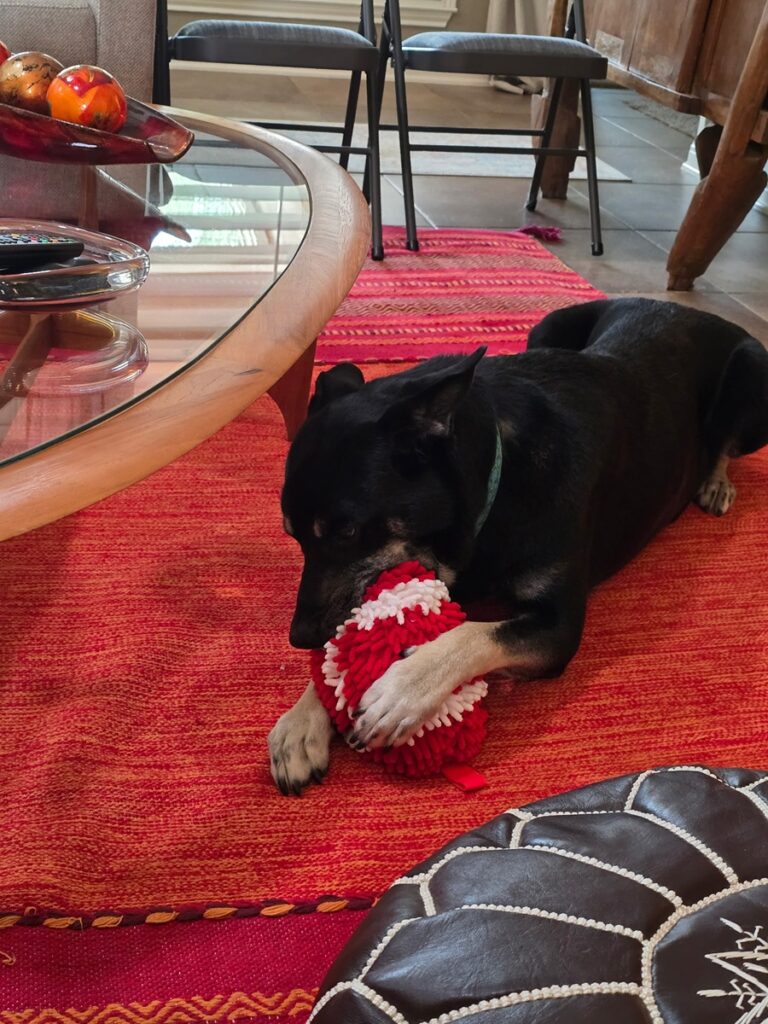
We wanted him to spend time with us in the evenings instead of going off by himself at night to rug-suck, so we bought him a chewy toy that has the same texture and we bring it out after dinner. Now he has the best of both worlds, so most nights he’s contentedly lying at our feet, this thing just shoved into his mouth, and everybody wins.
How can you find creative ways to make the work of writing more fun and enjoyable? That may involve creating or finding an environment that you love to be in while writing or editing or working on other tasks of your writing career.
It may mean making the work less isolated, for instance with Zoom writing sessions, or joining a critique group or writers’ organization, going to a conference, working with an editor or coach or publicist, taking a class.
And it certainly means finding the delights intrinsic in the work. I love to solve problems and puzzle out how and why something works, whether that’s analyzing a story or learning a language or baking, and I try to focus on that fun aspect of my work in editing and writing and course creation: Even amid the most challenging edit or content creation, often I lose myself in the contentment of noodling along puzzling out what makes something work, putting together theories and ideas, figuring out the best way to convey my thoughts to make them understandable and actionable—and yes, hopefully fun.
Read more: “Doing What You Have to Do”
You have to find what’s inherent in the activity or behavior that draws you to it—even amid the hard parts. Yes, my dog is as treat-motivated as any creature I’ve ever known, but he also genuinely loves learning and executing a task, so if I can turn something into a job for him to do, his delight in figuring it out and doing it keeps him eager and focused.
Reward, don’t punish
When my husband and I were planning our wedding I enticed him into tasks I knew he would be more reluctant to participate in by building in frequent rewards and treats: “We’re going to go interview a couple of photographers and then we have a cupcake tasting”; and “We need to select linens and then we’re going to sample the catering menu”; “We’re going to see another venue, and then we have a cupcake tasting.” (I got a lot of mileage out of cupcake tastings…positive training works with spouses as well as pets.)
Many authors use a reward system to get their daily word count in: “If I write a thousand words/finish this synopsis/send out five submissions, etc., I can have a long hot bath, a piece of my favorite chocolate, a hike with my best friend.” Give yourself a bye on some disliked chore or task for accomplishing a particularly tough goal. Allow yourself whatever pleasurable treat you can use as a carrot, rather than flogging yourself with a stick.
Find your freedom
I think what I love most about Liu’s story is how much “loose lead” she gives herself in this second chapter of her career. Rather than adopting the more traditional approach of single-minded, drilled-down, serious focus, she ends her practices when she’s ready, FaceTimes with friends right up till she’s on the ice, warmly engages with other skaters between skates.
She moves like liquid out on the ice, loose and relaxed, gliding through her routines as if they’re almost effortless. She tosses her head like she’s dancing at a rave, looks out into the crowd, lets her arms float away from her body, seems to ease into even her most complicated jumps. Watch her face in this video of slow-motion close-ups—she’s wearing a relaxed smile as if she’s contentedly knitting, rather than performing astonishing feats of athleticism in one of the most competitive and highest-profile sporting events in the world.
Alysa Liu is having a damn blast out there—on her own terms.
And isn’t that the way any artist wants to feel about their art?
Authors, how do you approach your writing and related work of your career? Is it a slog or a chore you have to check off, or an appealing pleasure you get to pursue? What do you do to orient your writing around the inherent enjoyments it offers, rather than focusing on the outcomes, obligations, and fears around it? How do you make your work and your career your own?
If you’d like to receive my blog in your in-box each week, click here.
16 Comments. Leave new
The week before Lui’s amazing performance, and her delightful story, I had come to realize that I’d lost the Joy of writing. So I resigned from two critique groups that, over the years, have been so helpful. I realized I need to step away. Watching Alyssa Lui’s win was like a reaffirmation of my decision. She is an inspiration to young and old!
Roi, good for you. Funny you say that–I also took away from her story that knowing when to step away is part of caring for our creativity. It’s always there for us when we’re ready and recharged. Enjoy the time! I love that you feel so good about what should be a healthy choice for any artist.
Thanks for talking about Liu and her joy! I heard her talk about it all in her interview on NPR and was totally inspired. Then I saw her skate. This is how I will forever more approach my work, from the heart and for the pure unadulterated love of it.
I haven’t heard her interviewed yet but I’d love to–she seems as if she’d be full of joie de vivre. 🙂 She’s an inspiration!
It’s so funny you wrote about Liu because I was just thinking about her performance and her approach to her craft. I watched her, knowing she had won the gold, and wondered if the joy I was seeing as she skated was imposed by my knowledge of the outcome. But I read about her backstory and realized that no, she genuinely felt joy as she skated. I also coincidentally heard an old podcast you were on where you spoke about finding the creative thing that you could feel fulfillment no matter the outcome. You obviously expressed it better, but ultimately I decided to work on writing the novels that I want and enjoying the process as much as I can because that is all I can control. I’ve started working on being okay with writing without tying it to how many people read it or even if they respond to it ( on substack) and very slowly I feel my desire to write increase because it’s ultimately for me and its value doesn’t rely on outside forces ( of course having readers is nice but it has been slowly liberating to work on this).
Ines, I love that your urge to write increases as your concern about how it’s received decreases. I try to remember that in every walk of life–the less I worry about how I’m perceived, the freer (and happier) I am. It’s a process. 🙂 Thanks for sharing this! I love hearing it.
Thank you so much for your interesting and insightful post today! It touches on a vital part of our lives as writers. I once read a book called Indian Boyhood by Charles Alexander Eastman (Ohiyesa) about a young boy growing up in a Native American village. The story was fascinating and what stuck with me for all these years is that Ohiyesa said he couldn’t wait to wake up in the morning and head out into the woods to hunt, fish and learn about nature. Of course, he and the rest of the able-bodied people in the village had to hunt and gather in order to survive. But it wasn’t viewed as a task or a chore, it was fun and exciting every day.
For me, writing is a hobby, not a profession. I’m retired, so earning an income from what I write is not necessary. I think this absence of pressure, just like Alysa Liu’s skating, makes all the difference. If the motivation to write, or skate, is achieving a bestseller or an Olympic medal, the pressure is intense and not all that much fun. If it is to write down a new idea for a story that pops into your head when you’re waking up, or to just enjoy the skating that day, it is a wonderful experience.
In a larger sense, I believe that is one of great tragedies of our civilization. We do many things because we have to, not because we want to. The pressure to achieve and attain recognition undermines our health, our relationships and our self-image. So, if I only sell 50 self-published books, hooraaayyy! The writing is still so much fun!
You know, Liu has been quoted as saying she didn’t care if she won anything or not in these Olympics–she just wanted to skate in them and show what she could do. (It reminds me of an old Baz Luhrman movie I love, Strictly Ballroom, where the main characters decide to dance their non-approved steps in the big dance competition because they stop caring about winning; they just want to dance their way.) I can’t always remember to do it, but when I can it’s just so liberating.
Yeah, I heard the obligation mindset you describe as “shoulding all over ourselves.” 🙂 Again, it’s so freeing to break out from under that…but so hard to do! Thanks for sharing, Jeff.
Oh, man! I needed THIS. I’m in the middle of revisions and am having trouble NOT thinking “am I ruining this story?” Thank you THANK you!
I’m so glad it hit the right note for you at the right time, Kimberly!
Thank you for sharing this Youtube video; it was refreshing to see Miss Liu skating so beautifully and with that much joy! Sometimes I approach my writing with enthusiasm, as an activity I have the luxury of pursuing. During the ten years I’ve been writing consistently, I’ve met many brilliant, fascinating people and love attending workshops, readings, and other literature-focused events. At other times, writing feels like a chore, and I think of other things I’d rather be doing.
I remind myself of the relationships that have been fostered through the writing community, how much I’ve learned, and how good it is for my brain to keep this creative endeavor going. I reward myself with chocolate and scented candles, with a trip to the mailbox, or a look at a few positive reviews on Amazon.
I make my writing path my own by setting annual goals, carving out a certain amount of time each week for it, giving myself a sabbath rest, and reading for pleasure. When I get discouraged, I tell myself I can walk away any time I want, for a month or forever. That kind of agency feels great!
Everyone uses that same word–joy–to describe her skate. It just radiated from her, didn’t it?
You mention agency–I think that’s so important for every creative. For all of us, really–I’ve read that one of the things that is hardest for people as they age is loss of autonomy, and I get that. I’ve designed a whole career around it, because it feels essential to have agency for my work. I like your techniques for claiming it in your own writing–including giving yourself permission to step away and rest when needed. I think it’s easy to forget that–or worse, push or guilt ourselves out of taking it when we need it. Rest is as important as the work side of things; the other side of the coin. Thanks for sharing, Lee.
I’m not a sports fan, and hadn’t followed the Olympics, but watching Liu skating with such relaxed joy and absolute mastery of her craft is going to stick with me. Thanks for sharing.
The joy of creating– when a sentence just lands, or I figure my way out of a sticky plot problem, or I take an awkward phrase and massage it into fluidity– is what keeps me coming back to my desk.
I also motivate myself with the reward of seeking out writing community, during Zoom write-ins, critique group sharing, attending book launches, or just grabbing coffee with a fellow writer. That was one thing I didn’t know coming into this writing endeavor that I would find so much pleasure in, since I can be a bit of a hermit otherwise. I’ve stopped seeing those connections as frivolous, and started viewing them as an essential and joyful part of my creative life.
Ditto on sports and the Olympics, Heather–but I heard so much about Liu’s performance I had to see it for myself. I’m so glad I did. No one oversold it.
I love the writing community you’ve created for yourself. It makes a big difference in this often isolating pursuit, doesn’t it? And there’s something wonderfully validating and communal about talking to people who love what you love, who get its weird challenges and the fact that we love it anyway. 🙂
Oh wow, I hadn’t seen this video until you said go watch it! (was tricky to track down from UK for some reason) That was totally worth the effort – absolutely loved it and her passion and fun she was having was leaping off the screen. I found myself smiling so much and clapping her as she went along! Amazing!
So funny you say about ownership.
I really feel in the last year I’ve cracked this. I write because I want to and because I’m good at it. I know most writers don’t like to say that out loud – but I will, I’m proud of the way I can craft words together and I’m not afraid to say it.
This new me has seen me getting even more commissions (now cracked ‘The Times’ – that was a newspaper I always wanted to be in) and unbelievably the sample I did for my agent in December (which never had any particular date in mind) and which she asked me for a proposal (and I quickly did on a Sunday morning) has now resulted in her taking it next week to London Book Fair.
Tiffany, I’ve written before, this isn’t my first rodeo. But when she told me that, I was bouncing off the walls. I’ve never had any agent take my book to the LBF and given I wasn’t even thinking that was the plan I am going along with the whole acceleration because – you know what – it’s fun!
I don’t write for the money (although it’s handy) I write for me. I’ve realised and accepted I’m very status driven. I don’t mean that in a way that I can brag to others – I just like bragging to myself. A bit like your dog likes rug-sucking 🙂 It makes me feel good.
I know that’s not something writers will easily fess up to, but I’m cool with it.
There comes a point where when you accept yourself – flaws and all – you can just get on with having fun being you!
Isn’t she just inspiring? I watched it with such joy–hers is infectious.
It sounds like things are going so well for you, Syl–congratulations! And isn’t it nice when it’s not just that you’re getting the results you hope for, but feeling satisfaction and ownership of your career even before that happens? I think that’s the secret to creating a fulfilling writing career we can sustain over a lifetime (or as long as we choose to).
Thanks for sharing your success–it’s always uplifting to hear from any writer.