

If you’d like to receive my blog in your in-box each week, click here.
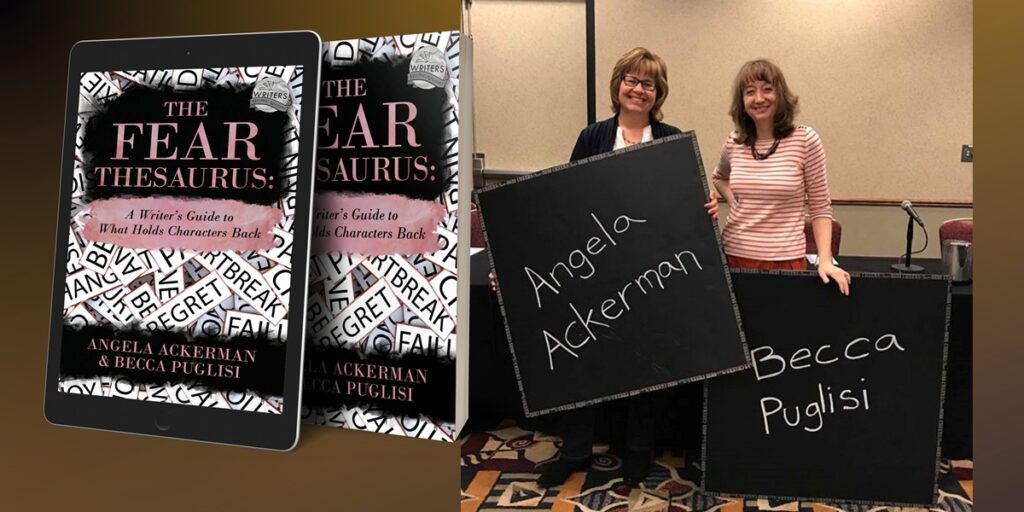
Angela Ackerman and Becca Puglisi may have dreamed of selling more than a million books (1.5 million so far, if we’re counting)—but the authors of the wildly successful Emotion Thesaurus and subsequent Descriptive Thesaurus collection (21 titles so far…and counting) didn’t set out to do it writing nonfiction craft books for other writers.
Both were fiction writers who met by fortuitous chance as part of a large online critique circle for writers and “fell in love with each other’s writing,” as Becca says. Angela lived in Canada, Becca in Florida, but they became long-distance crit partners.
Four years later Angela decided they needed an online presence and invited Becca to do a blog together. Pregnant and preparing to step back from her writing a bit, Becca instead took the leap and agreed.
In looking for something to write about, Angela says, “We did everything you’re not supposed to do as fiction writers,” and they started writing about writing. “Becca and I are total nerds. We love to learn. We love to share what we learned,” she says. “Even at that point in time we could see that we both really liked helping writers.”
The blog—The Bookshelf Muse—started tackling what Becca and Angela themselves struggled with as writers: exploring and conveying character emotion on the page.
As Angela puts it, “The more we understand about why people do what they do and how our past is connected to how we behave now…the more we understand ourselves, the better characters we will write because we’re going to write characters who are authentic.”
They were still thinking that their main career would be as writers of their own fiction—yet the blog began to gain traction. It grew into the first Emotion Thesaurus book and subsequently a whole fleet of them, led to their rebranded blog and website, Writers Helping Writers, and their subscription-based reference site for authors, One Stop for Writers.
Eventually they both realized they had to make a choice between pursuing their own fiction writing or focusing on the nonfiction resources, which had quickly grown into a juggernaut.
Luckily for other authors, they chose the latter, and their latest book, the Fear Thesaurus, just recently released.
Neither one regrets the unexpected path their journey landed them on, though. “We had all these ideas coming from our own areas of struggle,” says Becca, who came from a teaching background and discovered she enjoyed merging those skills and interests with her writing career. “It’s very rewarding to be able to do that.”
As a fan of the way their work bridges the complementary fields of psychology and storytelling (a fascination of mine as well), I wanted to interview Becca and Angela to learn more about their approach to the work they do, their career path, and their partnership. You can see our full interview on my YouTube channel here.
In the course of our wide-ranging conversation we talk about how they made the choice to shift from focusing on their own fiction to helping other writers with theirs; making the deliberate choice to self-publish; dealing with challenges and setbacks and being able to pivot; how making a business plan changed their careers for the better—and why every writer should make one; how AI is affecting their careers, and more.
And for my How Writers Revise feature, I wanted to learn more about their editing and revision process not only with this kind of nonfiction resource book, but how they do it as a writing team.
How Becca Puglisi and Angela Ackerman Revise
TYM: How do you edit—meaning how do you initially evaluate your manuscript and assess what may need developing or changing?
When we draft a book, we start with an outline and list of entries and then split the content, each taking half. Once these are complete, we look at the teaching content and thesaurus entry content separately. The thesaurus content is much more straightforward, with us switching halves and so there is a blend of both our ideas and voices. We ensure there is consistency – tense, stylistic choices, tone.
The other evaluation we do at that point is to look at the progression of ideas to make sure they follow a logical path. This looks a bit different for each book’s topic. For conflict, it might be to start with the minor inconveniences a situation causes, gradually escalating to ones more severe. For fear, if might be the smaller reactions listed first, and gradually the bigger, harder-to-repress responses. For emotions, facial expressions are listed early on, then full body description. We group our list of ideas in a way that will make sense for readers.
The teaching content requires more work, because we need to bring everything together in a way that flows logically, yet by nature, so much about storytelling is connected and so we may both cover something from different angles. This means some restructuring for the best fit, cutting duplicate content, and ensuring ideas flow from one to the next. Typically, Becca brings the halves together, flags the overlap, makes recommendations as to what to move and cut, and then I read the content as proposed to see if it works. I supply any missing pieces and write bridge content to bring it together.
TYM: How do you approach revisions—once you know the areas that need work, how do you go about doing it?
Once the structure is firm, we each go through the teaching content in turn, massaging the other’s content, adding our own ideas, noting what needs clarifying and using track changes to show what we’re suggesting. In this way, our voices and ideas are so blended it would be impossible for someone to point out what Becca wrote vs. what I did by the time we’re done.
TYM: How do you process editorial feedback, and how do you decide what feels right for your story and what to disregard?
Once Becca and I have gotten it to where we need outside feedback, off it goes to the editor. Once it comes back, Becca takes the first pass, making the no-brainer changes and leaving comments where she’s on the fence or even disagrees. It’s not that we believe we know better than an editor, more that we understand the content more deeply (especially the psychological aspects of human behavior and how a book’s topic fits within the ecosystem of our wider teachings). Sometimes a reword can change the meaning in a way the editor may not realize, or it removes our voice. So, in these cases, we try to be very careful. Once Becca is finished her pass, I weigh in, we make decisions and move onward.
TYM: What’s your biggest challenge in editing your own work, and how do you overcome it?
Angela: This might be different for Becca and myself. I think for me, it’s twofold. One, the more I learn about psychology, the more my language (and ideas) can become more complex. One of our biggest mandates is to write guides that are accessible to writers at any level, so I have to be careful about how I cover certain ideas and the terminology I use. Too, I have a chronic problem around trying to stuff the most value into everything, and this can cause me to tackle too much in any given book. Thankfully, Becca is very good at managing my quirks, and she call it out and is the voice of reason, reining me in.
Becca: I’m a minimalist by nature, so while most people struggle with including too much information, my writing tends to be too sparse. This means that when I revise there’s always content that has to be added to flesh out ideas or clarify things for readers. Because things are so clear in my mind, it’s hard for me to see where more info is needed; all that extra stuff feels like clutter to me. This is where critique partners are unvaluable—especially the ones that fill your gaps. Angela’s great at seeing the big picture, so she’s able to see where my writing is too thin and needs filling out.
Angela and Becca’s latest in their Descriptive Thesaurus collection, The Fear Thesaurus, is available as both an e-book and paperback.
If you’d like to receive my blog in your in-box each week, click here.
9 Comments. Leave new
The Accidental Career – I love that, and it is so true! So many weird things have happened between Becca and me that show us the universe definitely wanted us to come together and write these books. I am so thrilled we met all those years ago as fledgling writers!
Thank you so much for that fun interview and this post, Tiffany! You are an absolute gem!
I always love talking to you–and it was so great to finally “meet” Becca. I love the work you both do, and your approach with authors. Such valuable, useful, practical resources–but I love, as I said in the interview, that you don’t offer “formulas” or “rules” or templates for authors; just insights they can use for their own character development to deepen it and bring their characters and stories to rich, full, believable life.
I love your career path too–reminds me of mine, in that I always joke I came in through the back door in publishing, and had never really set out to wind up there. But like you, I’m so grateful I did!
Thanks so much for having us on, Tiffany. It’s always fun to traipse back down memory lane. We’ve made a lot of mistakes, but so many things have also worked out for us. There’s value in the good, the bad, and the ugly, so it’s all good to remember :).
Life is full of those unexpected twists, isn’t it? I’ve had to learn (and still do) how little I control–but what I love about your story is how you adapted, how you took what you couldn’t control and used it to inform what you could, and consciously built the career you have. And yes…I am always grateful for the road behind me–even the rough spots–because all of it brought me to where I am, which I wouldn’t trade.
I loved finally “meeting” face-to-face, Becca–thanks for such a lovely conversation!
This is a fascinating story, Tiffany! Thank you for telling it. The decision to do a blog with interesting information is just what I have been told to do by my marketing consultant. My questions are, how did the blog get initial traction? Did they have a large email list to start with? Did it just grow organically by word of mouth? Was there some lucky event? I am struggling to find my readers who are interested in and would appreciate my stories. That’s what made this story so compelling. Nice job!
🙂 I had a feeling Angela and/or Becca would weigh in on this more helpfully than I could…! And I see that Angela has. It’s such a moving target, Jeff–I don’t think what worked for anyone is a surefire formula for what will work for someone else: There are so many variables, even down to timing and happenstance–lucky breaks and connections, etc.
I echo Angela, though, that it helps to find the thing you love, and love to talk about. That’s what I did with this blog too, and it remains such a pleasure to write, and a pleasure to engage with the people who’ve found their way here to help create this community. I try to focus on the process, not the product: I kind of just build it and trust that they will come. 🙂 And if they don’t, I can’t control that anyway–I can just do the part I can control, and enjoy that.
Glad you enjoyed this post–Angela and Becca are so knowledgeable and generous with their knowledge.
Hi Jeff,
If I can answer, we started from scratch without a big personal following; in fact, the reason why we started the blog is that back then, everyone in the industry said the same thing: to get published, build a platform. Now there are so many ways to build a following, but back then, blogging was a bigger one.
I think we grew quickly because we identified a big need with our audience. People really struggled with how to show, not tell, and specifically, how to write strong character emotion. We blogged a lot of lists and tools to help with this, and so that jump-started our following.
If you are blogging, I would really understand who your audience is, what they are looking for (do they need help with something, are they looking to be entertained, something else?) and then set out to provide that to the best of your ability. Have conversations with people on other platforms around this same topic, finding people who would be likely to find your blog content interesting.
And be consistent with your posting, so people know when they can expect another post. It takes time, but it will happen.
You can find a lot of great advice online on how to build a following of readers, how to create a lead magnet, etc., but it all starts with you understanding what you want to write about and how to find the people also interested in that thing. You will have to seek them out on other platforms and spaces, but by building relationships with them there, you can draw them to you and your blog eventually, because they will want to know more. 🙂
Angela, thank you so much for answering my questions.
Congratulations on your achievements! I’m so jealous! Your advice is exactly what I was looking for.
Aw, thank you so much for the kind words. I’m so glad what I said helped.
I don’t know if Tiffany allows links, and I don’t want to assume, but a lot of our process for marketing and relationship-building is outlined on a special page at our site. So, if you ever need further help, scoot over to the Writers Helping Writers home page, scroll down, and click on the box that says “Business of Writing.” Lots of stuff there that may be of use to you. 🙂
You’ve got this! 🙂