



Why persistence, perseverance, and small steps matter on the unpredictable journey to writing and publishing success.
If you’d like to receive my blog in your in-box each week, click here.
Among the data and statistics being crunched and discussed in the wake of the midterm elections is one factoid that I can’t seem to get out of my head: South Carolina elected a Democrat for the first time since 1954—to a seat that has had only two senators elected to fill it in that time, both Republican: one for nearly 50 years and one for 23.
(FRET NOT! We shall not be swimming in the murky and dangerous waters of partisan politics for this post…just gazing into one little tidal pool for a moment. We’re going to look at the midterms conceptually, not politically.)
Here’s the part I can’t stop thinking about: Imagine, in every election for the last nearly 75 years, being a Democratic politician running for that senate seat.
What kind of hope do you and your party hold out for your chances in a state considered a firm stronghold for the opposing party? How do you muster the wherewithal and persistence and resilience to work as hard as a candidate has to in order to seek elected public office, knowing how infinitesimally small the likelihood is of success? How do you—or your party—do that over and over, election after election, when you suffer defeat after defeat after defeat? Why would you ever imagine you could succeed when so many have failed before you?
With odds like that, wouldn’t it be easier to quit trying, chalk it up as an impossible quest and give up?
And yet last week the unimaginable happened, and the impossible became suddenly possible after decades—generations—of failure.
This election isn’t unique in electoral upsets and unexpected outcomes; they’ve happened in any number of other elections throughout history, in both Republican- and Democratic-held strongholds. If we’ve learned anything in recent years, it’s that anything can happen in politics and elections, and no amount of prognosticating, polling, or precedent conveys any guarantees.
Yet opposition candidates keep trying in many of those “safely held” constituencies—because times change, and trends change, and people’s tastes and desires change, and timing and luck and countless other powerful influential variables are unknowable and largely beyond our control.
And because impossible odds are only impossible until they’re not, and the only certain way to ensure you never defy them is not to put your hat in the ring at all.
Why Every Step in an Author’s Journey Matters
You smart little readers, you; I’m betting you’re already riding the rail I’m laying here: Our business can be just as mercurial, just as unpredictable, and just as impossible-seeming as politics. You don’t need me to quote the stark statistics on getting published; most authors have (or quickly develop!) a clear understanding of how slim the odds are in getting off the slush pile, signing with an agent, being offered a publishing contract, or becoming a bestseller—and with every step closer to your goal they narrow even further.
Read more: “The Happy Harsh Truths of a Writing Career”
Why try?
I’ve seen authors asking this more and more lately, it seems, as publishing continually grows even more crowded and competitive—monumentally so since large-language-model artificial intelligence engines have resulted in an influx of AI-generated stories flooding the market.
What is the point, authors lament, of joining the fray when the chances of succeeding are so very, very small?
These are excellent questions.
I have great admiration for those who seek a career in public service for the right reasons—wanting to help make the world a better place for more people—and yet I can’t imagine enduring the grueling requirements for attaining office: the unfathomable, endless work involved, the money, the vulnerability and exposure, and the constantly shifting ground beneath your feet. As much as I’d like to “be the change I want to see in the world,” I don’t have the fortitude or wherewithal to put myself through that.
But what would we do without those who do shoulder those difficult burdens? I’m so grateful for the work and dedication of people who help make my community, my city, state, country, and the world a place that, by and large, has gotten progressively, cumulatively, incrementally better throughout history, in no small part because of their efforts.
Here’s another factoid that should blow our tiny minds: Most people, across vastly different economic levels, generally live better than a king in times past, thanks to electricity and plumbing and sanitation, advances in medicine and science and health, policies and programs that help care for the most vulnerable members of society—none of which would likely have come about if not for those who braved the daunting odds of becoming changemakers.
And what would our world be without the stories that illuminate it, and us, and can change our lives for the better?
Imagine a world where one of the eight children of a parish rector in a time when women faced even greater challenges and discrimination than they do now decided there was no point in even trying to publish her little stories after 14 years of rejections—and we never knew a Jane Austen book. Where a formerly enslaved man—with no formal education in a time when even his learning to read and write was a crime—never dared to seek to publish his writing, and the world never knew Frederick Douglass? Where Louisa May Alcott heeded dismissive advice to stick to teaching?
Think of the stories that have affected you, changed you, shaped you—not just in profound ways but in small yet meaningful ones, from childhood to now. The books that helped you figure out the world and yourself, the ones that carried you into other lives and other realities, that helped you form your worldview or moved you or taught you or comforted you or awakened your imagination, or just entertained and delighted you.
What if their authors had balked at the steep odds against their words finding their way into your hands? How might your life be impoverished?
The Work Is the Reward: Finding Success Along the Way
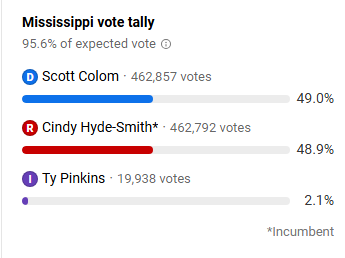
Even more, though, imagine how your own life might be impoverished if you give up the thing that matters to you because the chances of attaining the highest levels of success at it are thinner than the margins of the Mississippi Senate race (as of 1pm on November 4, less than 50 votes).
Plenty has been accomplished in the world even by the “losers” of political races—holding office isn’t the only way to help create change or serve your community, or even wield power, if that’s their main motivation. Neither is holding high-profile office; think of the impact on you and your community of your HOA, PTA, local school board, city council.
And plenty of people who do make crucial contributions to our world and create rewarding careers and lives in public service never run for a single office—just as “getting published” or making money or garnering good reviews or becoming a bestseller aren’t the only metrics that measure a successful, rewarding writing career.
In all cases, it’s the work itself that matters, not “winning” some designated prize for it. That’s where you’ll find the greatest rewards: intrinsically within the work, the writing itself.
But if you do dream of “winning the election” of publishing success, go into it knowing what it is likely to require of you, and what it actually looks like.
Just as with governing, most of the work of writing isn’t glamorous. It’s hard; it’s often thankless. Sometimes it may open you up to hostility and attacks, even if you are working hard to be good at it, and to do good with it.
Except in isolated cases it’s not something you get a hankering for and then step into and immediately succeed at; it usually requires many years of laying the groundwork, learning the ropes, making connections, and honing all the skills you need to succeed.
It’s often much more failure than success. And when success does happen, it’s usually incremental and isn’t absolute: votes and support are accrued one painstaking step at a time until they build to something meaningful—maybe over a period of years or even decades—just like words in a story, or the many manuscripts an author may write before the one that “succeeds,” or the dozens or hundreds of rejections that accrue before the acceptance, or every individual reader and sale or review.
There is no resting on your laurels. As soon as most politicians win office they must start turning their thoughts to building the coalitions and achievements and funding that will allow them to win it again, continue to create relationships and a reputation and a track record, because no elected office is permanent; it must be earned over and over. As soon as an author publishes one book they must turn their efforts to the next…and the next—and build a readership, and a good critical reputation, and a sales track record…because no publishing success is permanent either. Fortunes can turn in a moment.
Neither is an easy path. That’s not why people get into them.
And that’s the part you must know to your soul, in either path: Why do you do this? What is it you actually, specifically want from your writing career?
Read more: “Why Do You Write?”
And if you don’t achieve it, will it still have been “worth it” to you to pursue it?
If the answer to that last question is yes, then your work is going to make a difference no matter whether you “win” or “lose”—even if it’s only in the quality of your own life and the satisfaction of working at something that matters to you.
(Oh—and if you haven’t already realized the impact and importance of voting, read this.)
Authors, have you examined and articulated your core motivations for writing? Are they process-based—focused on the writing itself—or product based—focused on the results? How do you keep yourself motivated along the lengthy, challenging, uneven path of creating a writing career?
FoxPrint Editorial helps writers strengthen their manuscripts through developmental editing, education, and practical writing guidance. Explore more articles on revision, storytelling, and the publishing process.
If you’d like to receive my blog in your in-box each week, click here.
8 Comments. Leave new
Thank you so much, Tiffany, for this post and your encouragement. I am retired and writing for me is a hobby only, with no expectation of “success.” I do hope that my children and grandchildren read some of my work and get a lift from it. Whether my books get a wider readership depends on if readers like what I am writing, not so much on the literary agents and publishers. I am a bit of a cynic that way. I’m very comfortable selling a few dozen books to family and friends, just like I am happy to catch a nice bass in the lake nearby. It won’t feed the family but does have bragging rights!
I think success is what you define it as, Jeff–and it sounds like you know what yours is.That’s most of the struggle! 🙂
OMG in all the political analysis I’ve seen in the past week, I love this perspective the most. YES – such a relevant and timely metaphor for writers!
What do we care about so much that we are absolutely willing to try and fail?
Thank you so much for this! And for all your writing and courses and everything! Yes yes yes, let’s all persist!
It helps to reexamine our reasons for persistence periodically, I always think–it’s what fuels our resilience. Thanks, Niki–glad the post hit the right note for you!
Perfect analogy, Tiffany! Another timely and necessary post. Thank you so much for everything. 😀 xxoo
Thank you, Tara!
A great post, Tiffany!
I’ll note that Colom ended up winning, making him the first person of color (from any party) to win a senate seat in Mississippi since Reconstruction. Roughly, that’s 150 years.
That’s a long-view that is probably beyond me. LOL
I’m processed-based, my expectations beyond that low. Regardless, writing has enriched my life, and I have no idea how many lives I may have touched because of my involvement in writing, even if those people don’t read my books. In the crazy currents of time, who knows who might read something I’ve written after I’m gone.
I write the books I’d want to find on the shelf. I write about hope, and my hope in this life is that anyone who needs to read what I’ve written is able to find it.
I love your reasons for writing, Christina. I think of how my own life has been positively impacted by my creative work, and even if that’s all the reward I ever get from it, it feels like enough. I think creativity is among the noblest and most human pursuits, so fundamental to who we are–and the best of who we can be, and actually figuring out who we are. It can feel daunting when we’re trying to make a living at it, but as with politics, it helps to go into it knowing the journey is mostly uphill. Thanks for sharing your thoughts–and yes, the MS results make the point of this post even more effectively than the SC ones.