

What if you haven’t “made it” yet as an author?
If you’d like to receive my blog in your in-box each week, click here.
I was speaking with an author last week, youngish—I’m guessing early to mid-thirties—who worried that her writing career was passing her by because she hasn’t yet been published.
I remember that feeling. Back in my previous career I was an actor aging out of my teens, through my twenties, into my thirties and wondering when I’d break past doing small indie films and commercials and off-off-off-Broadway shows (and let’s not forget my brief stint as host of an Atlanta-based game show) and finally “make it.” I watched so many of my contemporaries progressing steadily up their traditional-career ladder or starting their families who seemed to be succeeding in their ambitions far more than I was.
I’m guessing many of us know the feeling of that urgency to succeed, the pressure of the clock ticking away the time we’ve given to our creative pursuits against our lack of being where we want to be. The weight of expectation we set on ourselves, comparisons to peers who may be farther along, whether fellow authors or in more straightforwardly progressing noncreative careers.
I remember being so afraid of all my training and work and investment in my acting being revealed as a waste, the silly dreams of a naïve child who didn’t want to grow up and “get a real job.” The fear of being a failure—worse than a has-been: a never-was.
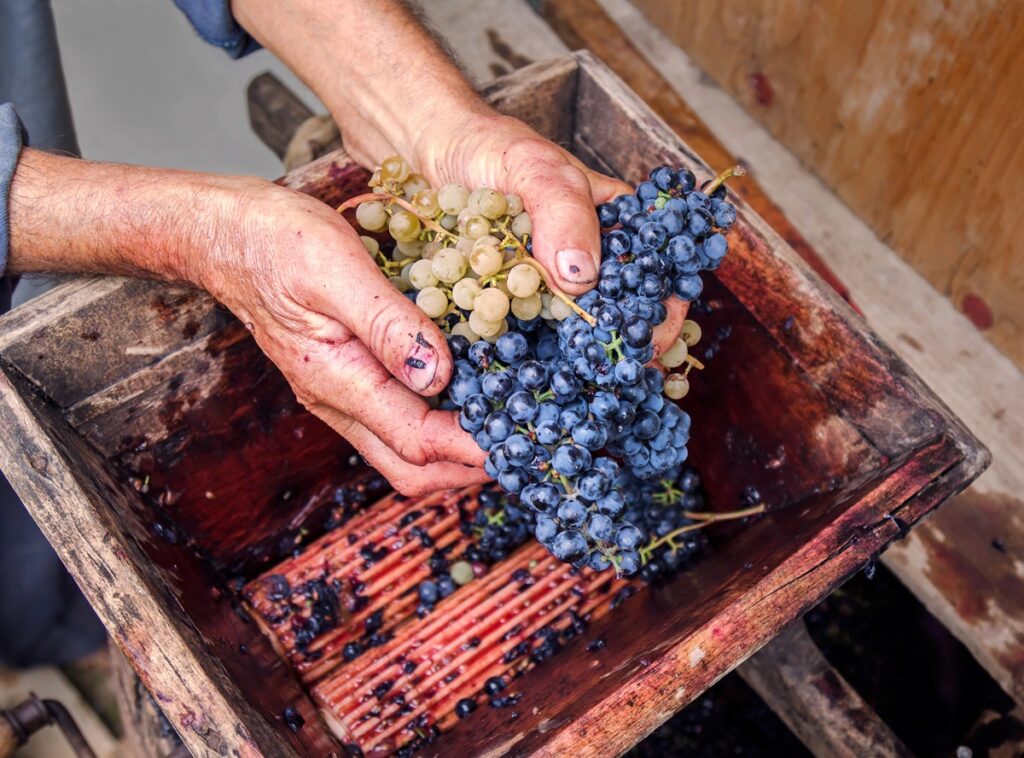
My life as a grape
But those aren’t the things that come to mind now when I think about those early days as an actor.
I remember the excitement of living in New York City—what felt to me like the nexus of culture and the world—“making it” on my own and supporting myself. That wasn’t wholly with my acting (of course)—I also worked as a server and took freelance work as a copyeditor, both jobs I enjoyed and work I was proud of.
I attended a prestigious acting school and studied my craft—acting, speech and diction, dance, singing. I went on auditions and booked some gigs but mostly didn’t. But when I did I got to spend days on a TV or film set or weeks onstage, paid to essentially play make-believe and do the thing I loved to do, surrounded by people as passionate about it as I was, forming a tight-knit little family of those who knew. Who understood what this wild, weird, mercurial, insanely wonderful career was like.
Those people were my community, taking classes or working monologues and scenes together, comparing tips on agents and auditions and productions shooting in the city, commiserating over cold pints at historic NYC bars, having raucous parties and nights out sampling the city’s club scene.
My life was full of freedom and artistic immersion and laughter—god, the laughter. Those are the things that stick in my mind now from that time. Those days were grapes on the vine, soaking in the sunshine.
The wine time
I don’t think what’s so great about getting older is that you have the proverbial fewer fucks to give. It’s that you know what things are worth giving a fuck about.
Back then, during my “grape days” when I was living all those one-of-a-kind experiences, I didn’t have the perspective I have now to just enjoy where I was and what I was doing. It was so easy to get hung up on the sorrows and struggles and frustrations and failures. The not-good-enough feelings, self-doubt, the pain of endless rejection. (You think a rejection letter is tough to receive? Try getting “No, thanks—next” right to your face over and over, often cutting you off in the middle of presenting your work.)
It’s so easy to get hung up on the sorrows and struggles and frustrations and failures of a writing career. The not-good-enough feelings, self-doubt, the pain of endless rejection.
But with the perspective of age I see how those experiences forged the life and career I have now. How learning to bring a character and story to life laid a foundation for my understanding of story and writing craft as an editor; how struggling to build an acting career taught me the skills I’d need to succeed as a freelancer; how performing taught me to be comfortable in front of an audience for the teaching and speaking I do as an editor and educator; how rejection and failure spawned the confidence and determination and persistence that are essential for creating a successful one-person business in a challenging field.
It’s only when grapes are crushed and fermented and aged that they turn into something more complex and layered and lasting. Something to savor and enjoy, rich with flavor and dimension. Otherwise they simply shrivel on the vine, turning into sad, nasty-ass raisins. (Demon boogers!)
I look back now at pictures and memories of my grape days with immense pleasure and pride. I believed in myself and I followed a dream right up until it shifted into a new one. I’m so grateful I took a chance on myself and my creative goals, committed to them wholeheartedly. I wouldn’t trade a moment of any of those experiences.
But I wouldn’t go back to them either.
Last night, over dinner with an author friend, we talked about where we are now in our careers—both making a comfortable living doing what we love, but neither of us up in the stratosphere.
We agreed we wouldn’t trade a single day of where we are now for where we were then—even if, as we joked, it would mean getting back the youthful bodies and faces we failed to fully appreciate at the time (but damn, I promise you I would now!).
With the perspective of age you’re freer to concentrate on what matters, things that actually contribute to your emotional and intellectual and overall growth and well-being, as opposed to all the things that get in our own damn way when we’re younger, like self-doubt or people pleasing or scrambling for status.
You’re free to simply enjoy where you are and what you’re doing, day by day by day, without worrying so much what it all means or what anyone thinks or what arbitrary marker would signify that you are finally a “success.”
You come to understand that success is lived on your own terms, by your own definition, marked not in the recognition you receive or the material rewards you attain, but in the doing of the work itself.
You realize that time is not passing you by or running out, but rather that you are blooming into the fullness of who you are and were meant to be with every passing day.
Continue Reading:
- “Measure Your Success by What You’re Doing, Not What You Want to Do”
- “Most of Your Life Is Medium”
- “Take Back Your Own Story”
- “When the World Sucks Your Creativity: Zoom in and Zoom Out”
- “Is It Worth It?”
I’m feeling all existential and contemplative today, friends. It’s easy to lose sight of the most important parts of our lives amid the noise and chaos of the headlines. What lessons, reminders, or experiences have shaped your view on life, or who you are now? What do you wish you could go back and tell your younger self?
FoxPrint Editorial helps writers strengthen their manuscripts through developmental editing, education, and practical writing guidance. Explore more articles on revision, storytelling, and the publishing process.
If you’d like to receive my blog in your in-box each week, click here.
17 Comments. Leave new
What a deliciously lovely post!!! Particularly loved this line: ‘Those days were grapes on the vine, soaking in the sunshine.’
I find it very pertinent to read because I’ve been doing some soul searching.
I love I get fired up and have the platform with a national newspaper to write my column and share my thoughts. But, I’ve realised recently, I would like to – on occasion – be a little less shouty. A little less angry about everything.
So, the book my agent said ‘yes’ to, but then I didn’t feel like writing, and now I’m wondering what to write and how to start and despite cracking the whip at myself, it’s way easier for me (and my bank balance and dopamine hit) to write another 700 word article…
And so another week passes, then a month, then a couple of months.
This week, though, I took control.
I said to myself I need to switch things up and start writing and thinking differently. With the help of AI I have now created myself a ‘Comedy Masterclass’ it has a range of exercises and drills to do each day. Alongside that I am also reading a comedy book (1 of 3 I’ve chosen) At the moment I’m reading Sally Holloway ‘A serious book about joke writing’.
It is fantastic. This is only Day 3, but I look forward to this time (I allow 2 hours per day) of stretching my brain and pursuing ‘forced fun’. It is playful and it makes me feel lighter.
Will it get me anywhere? Who knows! Fact is, I am having the most fun with words I have in years, and on account of Sally’s advice I’ve now ordered the Scrabble Family Dictionary, because apparently it contains lots of mischievous words which I can have fun with!
So, Tiffany, thank you for your words. Thank you for sharing. Know you are not alone!
Oh, less shouty and angry sounds delightful, doesn’t it? We’ve noticed this in our television consumption–we really need “palate cleansers” more lately, especially when so much of the shows our now seem a bit darker. (We’re not the only creatives feeling it, I guess!) Ironically I think most people would like more civility, connection, and warmth…yet here we are.
I love that you’ve turned your reticence with your initially conceived book into something so joyful and positive as comedy. (Laughing becomes increasingly valuable to me by the day–a rebuttal to what it feels like certain forces out there would like to engender in people, to keep us fanned up and pissed off…and thus easier to manipulate.) I used to do improv comedy with a troupe in Atlanta (more of those valuable skills I’ve carried into my life now), and a non-performer friend of mine has taken improv comedy classes and loved it (though it also scared her…but that’s not a bad place to be, creatively). I hope your comedy work continues to delight you! Thanks for sharing this, Syl.
Beautiful post, Tiffany. I’m loving being older (except for the looming knee replacement.) As you mentioned, there are no fucks to give and ALL the wonderful things that entails, but also, as the wine ferments, I can look back and truly appreciate what an amazing life I’ve lived. That young (hard body but the rest a mess) chick would be SO impressed!
I think that too, Laura–I often think that I’ve finally grown into the kind of person I hoped I would become. 🙂 Sorry about your knee replacement–but how marvelous that we live in a world where they can replace your painful one and give you back more mobility! I hope it was a success. <3
A thoughtful post, Tiffany. Thank you. Looking back, my pleasant memories are few for several decades of my life, yet my outlook on the past is that I wouldn’t return to it, even if its lessons serve me now.
This is a dangerous topic for me, so I’ll avoid details, but it’s also one that influences my writing. My past has supplied me with a vast number of experiences that I’ve drawn upon to write stories of friendship, hope, and kindness.
The advice I’d share with my past self would be to have stood up to the fear, even though I’d have had to have done so alone. One decision can steal decades, yet when we’re younger we think we have all the time in the world. It seemingly disappears in a flash.
I’m sorry for your struggles and trials, Christine. Yes, those are not the sort of experiences that tend to engender fond memories (but they forge us, I think, if we can grow past them). It sounds like you’ve found peace within yourself about your past, and that’s a gift. I’m glad you can still call up the pleasant memories, despite the painful ones. Thanks for sharing this.
“I don’t think what’s so great about getting older is that you have the proverbial fewer fucks to give. It’s that you know what things are worth giving a fuck about.” Tiffany Yates Martin
This should be on a plaque in one of those curiosity shops that we browse on a lazy Saturday afternoon. Your post today is profound and brilliant. I am 75 years old and a retired scientist, engineer. I spent my life trying to solve problems, some of which I helped solve, but others were myopic visions of some technological breakthrough that never got traction, never happened. Four high-tech, high-risk startups with delusions of the stratosphere. All four crashed and burned. So now that I have time, I write about solving the great problems of the world. No risk to that. But it’s fiction.
As you so eloquently put it, I wouldn’t trade a single day of those experiences. It was so exhilarating. And although I didn’t create a successful company, the risk was well worth it and I can look back and be proud of what happened, regardless of how much of my retirement savings was lost. Oh, and by the way, in the old days, before there was distillation, the strongest wine, known as sherry, was made from raisins, not grapes.
I love that you can look back even on the “failures,” Jeff, and be grateful for the experiences nonetheless, and how you grew from them. That’s part of the gift of age too, I think, don’t you? It’s hard to argue with “exhilarating” as your experience of those times–what more can we ask for? (I mean, besides great wealth and notoriety, of course… 😉 ) I wouldn’t even trade the hard time–they’re a big part of who I am now, and I like that person.
I’m going to trust you on the raisin-sherry, but that nastiness is unlikely to cross my lips…. 😉 Thanks for your comment, Jeff–put a smile on my face.
Needed this!!! Thank you, Tiffany. <3
🙂
I didn’t even start writing until well into my 40s and was published when I turned 49. It’s never too late.
That’s the beauty of our profession! You can write right up till you croak, if you want to. Much less age-related discrimination. 🙂 Congrats, Nancy! Publishing is always a milestone.
As always, great post.
I’ve had several careers. I’m unquestionably a raisin.
I wish I had said, “Focus on what you can control; the rest is going to happen anyway,” first, but somebody beat me to it. I still say it like I invented it.
I’ve written two novels (well, much edited drafts) and a self-help book, and hidden several other unfinished works somewhere on my hard drive.
I’m still working on my first novel and have been longer than I’ll admit to. I’m the only one who can make it the best book it can be. (That doesn’t mean I won’t need help.) With a fresh query letter and a new strategy, I’m about to start querying again. Other people will decide if the book is saleable, and if they want a part in that.
My book is a lot better than the early drafts, and I’ve learned so much about this wonderful art/discipline of writing; I learn more every day.
I’m grateful for the fewer fucks to give (and to whoever said that first.) but sometimes I miss the passion I had when I was a juicy grape.
Nah, Bob, that doesn’t make you a raisin–it makes you a complex wine aged in a series of casks. 🙂 I read a stat somewhere that said the average person changes careers–not just jobs–something like five or six times within their lifetime, so I think you’re in good company. I always thought it weird that we were expected to declare a major and know what we wanted to do as teenagers–as if we knew all there was to do; as if we wouldn’t evolve over our lives, as if there were just one thing.
Yeah, I miss the juice sometimes, but I still wouldn’t go back if it meant losing everything I’ve learned along the way, mentally, emotionally, spiritually. Despite the wrinkles and sags and aches, it’s still worth the tradeoff to me. 🙂
Good luck with your querying, Bob! (Pro tip you may already know: when you query refer to it as a manuscript and give your specific fiction genre, rather than calling it a novel; technically the latter doesn’t apply until it’s published, and it’s a subtle way to look seasoned and professional.) I’d love to hear when it’s published.
Thank you so much for your good wishes and your tip. I’ll certainly make use of the tip and remember and hold onto the good wishes. As to the other, you’re gonna be one of the first people I celebrate it to if I ever get a request for the MS. Have a great weekend!
Thanks for this thoughtful meditation on creativity and how we view it differently through the lens of age. The game looks and plays a lot differently the closer you get to the end zone – is there time to devote to the long trail to publication, or are there other considerations that come to the fore – such as personal growth and satisfaction in the act of writing itself?
I must confess from the perch of turning 71 next month, and having spent my professional career in a field not related to writing, I treasure these retirement days living in the creative moment. The thought of being a ‘has been’ never crosses my mind because the marker of success transmutes over time from external validations (get an agent, get traditionally published, etc.), to internal reflection – am I getting closer to expressing my imagination in a way that could connect with the readers who would be eager to read my stories – whether or not money changes hands.
I look around the webinar and summit Zoom rooms and see more and more members of my tribe – the elders who now have the time and means to invest in their own visions, many of whom wanted to write for years but were not able to do so. I’m glad to have options like self publishing and writing on Substack as means of reaching that audience – options that were not dreamt of 30, 40 or even 50 years ago.
It does play differently closer to the end, Phyllis. Weirdly, to me, in a good way for the most part: It makes me mindful that time is finite and to use it, stop waiting to do things “someday.” As you point out, I think it points you toward what matters most to you, what actually makes your life meaningful–day by day, not in a “legacy” sense. Just, How do I want to live in whatever time I have left? Honestly that’s probably a healthy mindset at any age.
You’re right–our field seems heavily populated with people on the older side of the spectrum, I’m guessing for the reasons you posit. It’s when people often have time to devote to things there may not have been space for amid raising families or building careers or caring for others. But I often do wonder if part of it isn’t this mindfulness of using our time as richly as possible, and the perspective we gain with age that lets us perhaps explore our creative sides more deeply. Enjoy your writing, Phyllis–and I hope you find the readers who love your stories.