

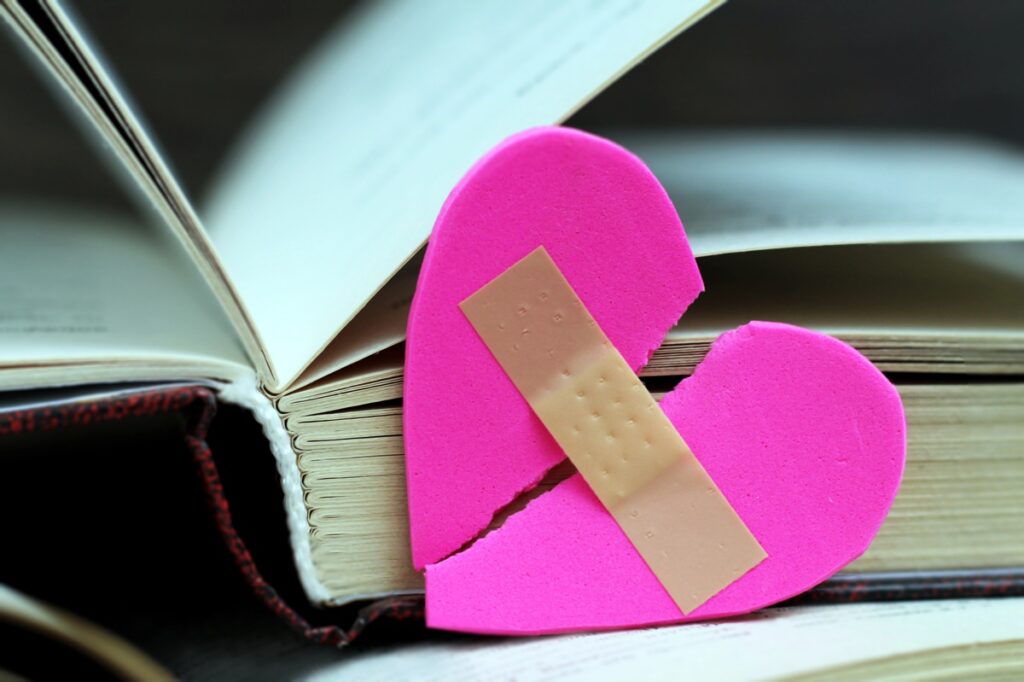
When to stop working on a story if the relationship just isn’t working out.
If you’d like to receive my blog in your in-box each week, click here.
Having married relatively later in life, in my forties, I dated a lot, so I well know that dating, as I still remember vividly (and as this recent New York times quiz strikingly illustrates), can be tough. And breakups are among the worst parts of dating: the disappointment, the awful execution, the often painful aftermath.
Yet I’ve always been fascinated by relationships, my own and all of my friends’: It led to my writing a four-book series called the Breakup Doctor and a regular feature for the Huffington Post, both all about relationships and what can go wrong in them. I love analyzing what makes a relationship work and why breakups happen: what led up to them, how to do it, and most of all, how you know when it’s time to let go.
I say all that to establish my bona fides on ending things that may not be going where you want them to at the moment, so perhaps it will lend some credence to my case for how to know when it may be time to let go of a story that just isn’t working the way it should.
Most every author knows the pain of the manuscript that winds up in the drawer instead of on the shelves and in readers’ hands (and if you don’t yet, you very likely will). Abandoned stories are a part of life as a writer, the same way that breakups are an unavoidable part of most people’s dating life.
Despite your best intentions, ideas, and vision, sometimes a story simply won’t come together the way you want it to—no matter how many times you revise it…even with the help of a professional.
How to know when to let go of a story
Just as in any relationship, if you pay attention to the signs and are honest with yourself, it can help you determine if you’re just going through a rocky stretch worth pushing through or it’s time to go your separate ways.
- It isn’t the right fit. Sometimes you may get into a long-term relationship with a story even though, really, you know you were never right for each other. Maybe you wanted to try a genre outside your usual interests or reading habits—walk on the wild slide for a bit. But amid the day-to-day reality of your time together, your differences throw up roadblocks between you that may feel increasingly difficult or unpleasant to overcome.
- You’ve lost the spark. Oh, sure, things started off passionately exciting—the newness of that fresh relationship, learning about each other, lost in your own world when you’re together and thinking about that story all the time when you’re not. But then real life sets in—with its hardships and challenges, its relentless routine, its pedestrian plodding. Suddenly you feel your story holds no surprises for you…or you don’t even care to try to discover any. You’re just slogging along, gritting your teeth and determined to see this thing through because, dammit, you committed.
- You’ve (both) changed. It’s nobody’s fault…we all evolve, and if we’re lucky we grow along the same path. But sometimes we don’t—you go one way and your story goes another. Be grateful for the time you spent together, the memories you made, and all you learned from each other…and then set each other free so you can fly your own way.
- You let your friends too far into the relationship. Even when you’re doing it, maybe a little voice is telling you not to let everyone know everything about you and your story. Not to let so many people all weigh in on what they think is wrong with your relationship and how they’d fix it if they were you. Sure, maybe a trusted friend or two can be a confidant worth consulting, but if you’re throwing open the doors to all and sundry to give their opinion, you’re going to get so many points of view that you’ll lose sight of your own—and lose faith in your own judgment. After a while you’re just reducing your story to the lowest common denominator, trying to follow too many directives, and before you know it, whatever made your relationship special has been diluted and lost.
- That bastard is ghosting you. Sometimes there’s no knowing what went wrong—the story just slips away. You show up day after day, but the story doesn’t. You never hear from them anymore. No matter how much you reach out, try to get back in touch, they’re just gone—ghosted. You know what? F*** that guy. If your story just won’t respond no matter how hard you try, leave it in the rearview and find yourself a story that will.
- You can’t fix what’s gone wrong. Sometimes things simply don’t develop the way you hoped, no matter how hard you work or how much you want them to. Maybe there are foundational flaws that would require so much of an overhaul to address that you may lose everything that initially excited you about this story; or maybe your skills and experience don’t yet match up to what an especially complex or difficult story requires; or you’ve worked yourself into a corner you can’t see any way out of and you lack the energy or impetus to try. There’s no shame in throwing up the white flag and letting that story go.
There’s no shame in letting any story go—no matter how much time or effort you’ve given it. If things aren’t working and it’s sucking the creative spark out of you or undermining your confidence in yourself and your writing, or it’s just begun to feel like a slog that you have to finish because of the sunk costs of all your time and effort or you’re dying to just submit already and get published, let it go. You’re not doing either one of you justice by trudging grimly through or racing to the “altar” of publication.
Sometimes the greatest expansion and benefit you can experience as an artist lies in knowing when to let one project go…and use what you’ve learned to continue to grow.
How to recover from a breakup
That doesn’t mean it’s not hard, and it doesn’t hurt. It is, and it will. But the only way forward is through it—let yourself feel and mourn the loss, and then move on.
Just as in any relationship, of course, you have to do the work on yourself to make sure you’re in a healthy, positive place. Continue to learn your craft, master your skills, address the fallout from a “failed” story so it doesn’t undermine your confidence or creativity…and then turn your attentions to a new lover so you continue to grow as a writer.
That’s right: The best way to get over an old story is to get into a new one…or something like that. Find a story you’ve got that spark for, and take what you learned from what didn’t work in your last story to make sure this one starts out on the right foot, and that you know how to sustain your relationship and build it and see it through all the way to “The End.”
The worst thing you can do after the inevitable breakups that are part of any author’s creative path is to wallow in them, or use it to flog yourself for your shortcomings. It’s not you, darling, it’s them! And even where you did contribute to your downfall together, it taught you to do a little better this time around…and the next…and the next. Not one word of those efforts was wasted.
And—every now and then, even if things didn’t work out the first time—one day you may return to that old story and realize that finally your time has come.
Breakups aren’t always forever
Sometimes you and a particular story might just be in the right relationship at the wrong time. I’ve shared before that my last novel, The Way We Weren’t (published as Phoebe Fox), was the first one I ever attempted—fifteen years before it found its way into publication. I put that story aside many times over those years because while I still loved it, it just wasn’t our time yet: I didn’t have the writing skill, the life experience, to tell it the way I wanted to.
I had to grow a bit more to be able to do justice to what was probably the story closest to my heart. We both did, that story and I. Over the years we’d get back together for a while, give it another try, get a little farther, but there was always something that kept things from working as well as I wanted them to and we’d have to call it off again, take time apart like Ross and Rachael on a break.
But I never really gave up on that story, even when it was lying in the proverbial drawer, even when I was in relationships with other stories. I’d think about it from time to time, hoping that one day maybe we could be the right fit. With us (also like Ross and Rachael), it was always on the table.
And one day it was. We wound up having a beautiful relationship, and that story helped me reach one of my goals for myself as a writer: the Big Five publishing contract I always wanted.
We just had to wait for our time.
Speaking of time, if you have a few minutes to spare click to see a fun, ridiculous video I made about the loooong road to publication for The Way We Weren’t, and how it changed over the years in revision.
Authors, I want to hear your manuscript-breakup stories: the juicy ones, the messy ones, the painful ones. How did you know when it was time? What let you finally let go? What did you do to get over that story—and what did you learn from it?
FoxPrint Editorial helps writers strengthen their manuscripts through developmental editing, education, and practical writing guidance. Explore more articles on revision, storytelling, and the publishing process.
If you’d like to receive my blog in your in-box each week, click here.
24 Comments. Leave new
I think the sunk cost fallacy is often at play when a writer can’t let go of a story that isn’t working. We’ve put in so much time and effort, it seems like we have to keep at it or all that time would be for nothing.
Having abandoned a novel I worked on for ten years (I did other stuff in those years, too!), I realized that 1. whether I finished the book or not, I’d never get that time back; 2. I was learning the entire time I was writing and revising even though that book never got off my hard-drive.
Abandoning anything one has worked on for a long time is painful but I wish more writers would embrace it as part of the process of becoming a writer. The novel I wrote after that abandoned book was “the one.” I knew it. I could feel it.
It makes sense–we hate to think we’ve “wasted” time or effort or energy or money. I recently cleaned out my closet and found myself wanting to continue to hold on to things I hadn’t worn in years because they were “perfectly good” or still fit or because they were expensive or nice. But I finally realized that they’re already “wasted” in the closet if I’m not wearing them. Food is as wasted in your stomach if you’re full or not hungry or don’t want it as it is in the garbage. I’m learning it’s better to cut your losses than keep pushing on something after its moment has passed just because of whatever you may already have invested in it.
And that also speaks to your other good point about all you learned from the process. None of that effort in even our abandoned stories is wasted because you’re learning from it; it gets you where you need to go. When I wrote fiction I’d often wind up with almost as many words in my discard file as in the final draft, but I had to write them all to learn who the characters were and what the story needed to be. And as you say, if I hadn’t been willing to let go of that first manuscript and work on others, not only would I never have learned what I needed to, but I’d never have had five other novels published. Thanks for your insights!
Aww what a super post! Really resonated with me. Thanks so much for your inspiration!
Thanks, Syl–glad it hit a chord!
Loved this post…and that video you linked to of your journey to publication is a must-watch! Every writer’s conference should show it at some point…to neutralize angst among aspiring authors, embrace the notion that good things take time, give us permission to kill our darlings, and have a good laugh. (It’s clear you have some acting chops!)
I came very close with a top five publisher a couple of years ago with my speculative thriller (met with the editor etc.) and felt a bit “left at the altar” when it ultimately didn’t sell. Felt pretty crushed. Went on to another project, learned a lot, and wrote, wrote, wrote. When I returned to the prior manuscript it was so obvious how I could make it better. I’ve been revising it (major surgery first, now in the process of smoothing out the seams). It would have been WRONG if that book had sold as is…not the project the present-day me would have been happy with. (And your point about listening to too many voices and diluting your own vision is spot-on!) It is hard to get back in the game, but such an important part of the process if you want to gain the clarity and confidence to know what’s right for you. As I just read somewhere, “you’re either winning or learning”.
Congratulations, Tiffany, on your website being recognized as the wonderful resource for writers it is. And thank you as always for being so generous with your wisdom and encouragement!
Pat, I have already had occasion this morning to quote “you’re either winning or learning.” I love reframing what we often call “failure” as just part of the process of learning–which sometimes includes abandoned manuscripts.
I’m sorry about yours–coming so close made it sting even more, I’m betting. But I love that with hindsight–and increased skill and knowledge–you realized why that story wasn’t ready and were even grateful it wasn’t published so you could eventually make it what you wanted it to be. (Those unanswered prayers can be such a blessing in hindsight!)
Thanks for the kind words about my website, Pat–and my silly video. 🙂 I did have fun making it….
Congratulations on your website award. And what a great video!
I have two novels in a drawer right now, but I fully intend to go back to them. I have no doubt that a fresh set of eyes, along with my improved skills, will be able to revise them into something to be proud of. Regardless, Creativity is never wasted. I had some wonderful days writing them.
Thanks for your post.
It’s never wasted! And often growth as an artist combined with objectivity and distance can give you the fresh eyes and skill you need to go back to those abandoned stories and whip them into shape. Thanks for the comment, Ada–and the kind words!
I’ve had stories like that where I loved the premise but my skills weren’t up to it, then I wrote them later and was really glad I waited.
Sometimes you have to wait, I think, for your skill and ability to catch up to your vision. 🙂
A couple years ago, I set aside a manuscript that I’d worked on for years, but had received lots (and lots and lots) of rejections during the query phase. Eventually, I submitted a portion of it for professional critique. She had some really good insights, but I was deep into a different story, so I set it aside. Last week, it occurred to me the reason I’d never been able to crack the shell of that older manuscript is 1) I was still too close to the subject matter and 2) I’d possibly told the problematic chapters from the wrong character’s POV, one I wasn’t ready to inhabit during the initial drafting. I just started scribbling out some scenes from an entirely different POV…and there might be a spark there…we’ll see if it leads to magic.
As always, thank you for the honest and supportive post.
Objective distance can work magic all on its own. It lets you see things more clearly and find new approaches, as you did, when you can get out of the box we sometimes wind up in when we’re buried in a story.
I do believe that most of the books in the drawer, if they had a good premise and you’re still excited about them, can eventually find their way out if we want them to.
Right now, I feel so tired I can’t see the story. I know it was s temporary and requires an editor’s eyes.
Sometimes all it needs is some time/distance, and the help of an objective eye. I hope that gets you back on the road, Margie–but meanwhile, sounds like taking a break for a little while might help refill the well. I’ve learned the value of rest–knowing when not to bear down and work.
Agreed, keep those treasures for the right ripe time.
25 years ago, i wrote 120K words in about 6 weeks while I waited for … who remembers. For over two decades, and multiple computer upgrades and updates, I transferred that file to new Word versions, new computers, and new folders. In July, I opened it, and started editing, trimming 8K words per chapter. It’s time has come. Mostly, I groan, did I write that, and keep it for 25 years? What more fun is the few times I go, huh, 25 years ago I wrote a great sentence, wow, yay me.
120K words in six weeks! Wow…did you take the Limitless drug? 😉 I love that it’s percolated for wo and a half decades–I’m betting with the perspective and skill you’ve developed in the meantime, it’s taking shape more satisfactorily. Hope it turns into something you’re happy with–thanks for sharing this! I was just talking to an author this morning about the value of occasional breaks from a manuscript and citing all the authors on this post who’ve shared their experiences with books in the drawer.
This post was valuable not only for writers like me but for life in general, Tiffany. Thank you so much for that. Your perspective is so mature and insightful. The very first novel I wrote, although I was over 50 years old, took me four years to write. The comments from my beta readers were not at all flattering. So, I put it under my bed for 20 years and recently have completely rewritten it with the benefit of 3 more books under my belt. The premise of the story excites me just as much as it did twenty years ago, but I like to think my craft has improved, in large measure due to your courses and counseling. The rewriting process is very satisfying and cathartic. I guess it is possible to link up with old girlfriends after all. Maybe you never really do get over that first love!
So often that’s how it happens with retrieved “books in the drawer”–when we come back to them we often have greater skill and perspective to determine what, if anything, is worth working on–meaning are we still fired up about the idea and is there enough to build on. (Sometimes you broke up for a reason and it’s best to stay that way…. 😉 ) I hope yours continues to go well, Jeff–thanks for the comment (and kind words, as always)!
This was a timely read. Last year, after I had revised a novel multiple times with my editor’s help, I started sending it out to publishers. However, after the first rejection, I began to receive feedback from fellow writers that it wasn’t ready or even the right vehicle for my main character. I began revising another novel with the same character, but a few months ago I realised something was missing. Off, seriously, I said it needed another murder. Note it was, or rather is, a police procedural, and the main character is the detective. Realising yet again that something wasn’t working, I called a halt to the revision and reverted to a different novel, an Alternative History that I drafted some years ago. A few years later, it feels even more topical than when I first wrote it. I’m glad I’m working on it and rediscovering the characters. Your post has confirmed that I probably chose the right project. Third time, lucky?
It’s hard to know when stepping away from a project would be useful to help you move forward with another one, or when it’s jumping to the next shiny new thing when revision gets hard (and it almost always gets hard!). I think the answer to how you know you’re working on the right project probably involves when you’re still invested in it and feel you’re making progress. Good luck, Roland!
Tiffany, so much of this resonated, but beyond that, this article made me smile and laugh out loud, so thank you!
🙂 This makes me happy to hear. Thanks, KT!
I recently decided that I had too many projects to devote the time and attention that my novel, which I started in January, deserved. Oliver Burkeman tells us that you can’t do everything; that hard decisions must be made. So, I made an intentional choice to button up the novel as one does a summer cottage for the winter. I wrote myself a nice note with my current thinking, links to the important documents, and even made space for ideas that might come to me before I go back on January 1. By doing this intentionally, it doesn’t feel like abandonment or loss. It feels good.
I LOVE Oliver Burkemann! He often gives me good perspective too. I love the deliberate way you went about putting this one aside (for now)–and the note to self! That’s clever not only to help articulate your reasons for stepping away from a story, but to spark your thinking when/if you return to it. Thanks for sharing the strategy, Janet–I’ll borrow it myself. 🙂