

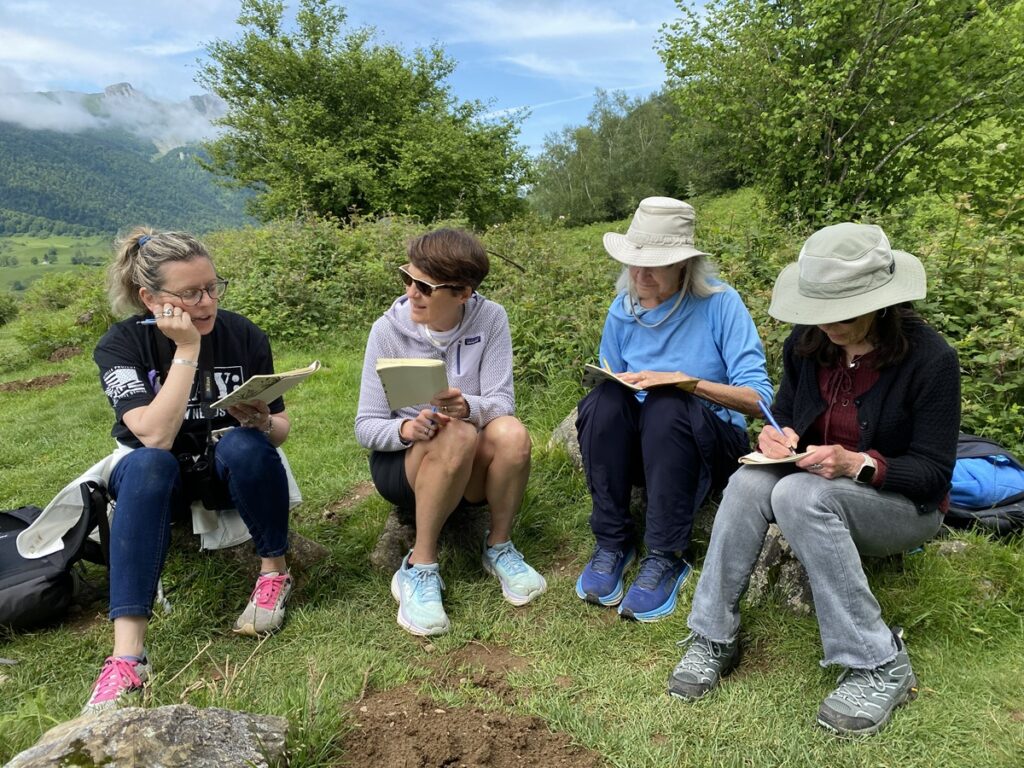
Writing retreats, workshops, dedicated writing time, and creative “skillcations” aren’t rewards you have to earn—they’re choices you can make simply because your craft matters to you.
(If you’d like to receive my blog in your in-box each week, click here.)
This month an article in the AAA magazine caught my eye: how to create a “skillcation”—time away to explore some hobby or interest or skill.
The hubs and I have very different ideas of what constitutes vacation. For him it’s a chance to relax, take everything off the agenda, and just chill. For me it’s a chance to do all the things I may want to cram in, knowing I may never be back in that destination again.
So this article—which profiled “skillcations” like learning tango, apothecary arts, or trail guide skills—struck right at my type-A, activity-driven, multitasking little soul. I like to do, and one of my favorite things to do is learn. Because I keep a busy work schedule I never have enough time to learn all the things that interest me (ask me about vegetable gardening and ASL and pretty much every other language on the planet).
So a vacation where learning is the whole point, dedicated to spending time mastering some new skill or knowledge, sounds like nirvana to me.
See my recent post about our last vacation and all the things I gleefully learned about the history and culture and architecture of the places we visited.
Vacation doesn’t have to be the Madison Avenue image of “turning it all off and shutting it all down.” What if it’s a chance to turn it on or up—to give ourselves time to explore a thing we love or are interested in away from the distractions and demands of “real life”? What else is life than exploring our interests?
Prioritize Your Writing Practice
On a recent phone call with an author I’m working with, she mentioned that she was hosting an upcoming creative retreat for some of her writer friends at her home.
I have a writers’ retreat of my own coming up myself in France—my very first one, a glorious invitation I nonetheless agreed to only after three days of pondering whether I could spare the time from work, and justified only because it is work, since I’m co-leading the retreat. (I wrote about this ridiculous decision inertia here.)
As this author told me how she and her fellow writer friends planned to make time for their writing over a number of concentrated days, I realized that as enchanted as I am by the idea of dedicating an entire vacation simply to the pursuit of a skill I’m enthusiastic or curious about, I don’t walk my talk. I’d feel guilty planning a trip like that just for myself, worrying that it wasn’t fair to my husband, or that it didn’t make financial sense to spend money on learning a skill just for its own sake with no payoff or end game to justify the time and expense.
Let me stop right here and acknowledge that it’s a luxurious privilege to even have the option to consider something like that. Growing up my family did not take vacations, unless you count the long road trips when we piled into the car to go stay with family for a few days. We didn’t have money for anything so fancy as an extended beach trip or resort getaway, and certainly not a trip overseas. Even as a child, my vacations had to be justified.
Things are a little easier for me now. Yet even so that old mindset creeps in and tells me it’s silly or a waste to dedicate vacation time and expense to something so “pointless” or “selfish.”
Regular readers may know I have long been talking about the next book for writers that I’ve been working on, about character development. Many times I’ve imagined how delicious it would be to go away somewhere for a long weekend—or even longer—and give myself unmitigated time to work on it, rather than trying to cram it around the many other business commitments I have. To take a writing vacation where I don’t have to consider anything or anyone else and can fully focus on this thing that’s meaningful to me.
My books, while a key part of my business, are not a main source of income for me. I can’t justify a trip like that on my business balance sheet because the book is guaranteed to turn a healthy ROI, any more than the thousands of dollars I spend creating the audiobooks for them ae likely to yield anything more than pennies on the cover price (thanks to extortionate audio distribution charges).
What if our writing needs no justification?
But they mean something to me. I love creating these craft books. I love recording them. I love sharing them in the hopes that they may help writers with their creative efforts. What if giving myself a skillcation of my own to work on that book is justification enough for doing it?
More to the point…what if it needs no justification?
Ask a child why they want an extra piece of candy or a new toy or anything else they desire, and they’re likely to answer, “Because I want it.”
We grow up being asked why we want the things we do as if we must justify our desires, but kids intuitively have this figured out: Our desire is justification enough.
Why Writers Feel Guilty Spending Time on Their Craft
Yet for some reason, often authors feel they aren’t entitled to indulge their creative work unless it materially pays off—in writing a manuscript that sells to a publisher, turns a profit, becomes a bestseller.
Just since I’ve announced the France retreat I’m doing in August with Allison K Williams, I’ve heard from a number of authors telling me they wish they could go but they don’t feel as if they can justify splurging on a trip dedicated solely to improving their writing, or they feel guilty for taking the time “just for themselves.” Once they’re “successful,” they tell me, maybe they’ll do things like that—as if then they will have earned the privilege.
But I wonder why it often seems we put that stricture on our writing, but not anything else we do simply for the sake of our love for it? One author I’ve worked with, Donna Barten, recently sent me this post from her gardening blog, a labor of love she writes about another labor of love—neither of which, as far as I know, she intends to turn into a profit-making business. Another author, Mary Knight, writes a Substack about food, travel, and gardening.
I have a friend who takes pickleball vacations so she can play even more than the five to seven times a week she already does. Another friend takes elaborate trips to Africa, Antarctica, and other locations mainly to practice her budding love of photography–not to try to be a professional photojournalist; she just loves it. She spends untold hours waiting in awkward or uncomfortable perches for the shots she hopes to get, spends more endless hours editing the images. Yet she lights up when she shares with our friend group the astonishing photos she’s taken.
Are these expenditures of money and time and energy somehow not valid or “worth it” because these people are never planning to turn a profit from their interests? Given the joy each of them takes in pursuing them, it’s hard for me to imagine that’s true.
What if you bring that same idea to your writing? What if you allow yourself to have space and freedom and time and discretionary money to dedicate to this pursuit that most writers I know feel profoundly passionate about, find deeply rewarding in its own right?
You don’t have to validate that attention and effort by giving it a reason: “I want to make money” or “to support us” or any other justification we give to try to make it feel legitimate to pursue this crazy, mercurial thing.
We want it because we want it, and life is short, and maybe it’s enough that we love a thing and simply want to pursue it.
Authors, do you find yourself justifying the resources you dedicate to your writing? If so, how do you manage those self-defeating attitudes when they crop up? What methods or approach do you use to determine how much time, energy, money, or attention you give to your creative pursuits?

If you’re interested in our retreat in Pau, France, learn more here.
FoxPrint Editorial helps writers strengthen their manuscripts through developmental editing, education, and practical writing guidance. Explore more articles on revision, storytelling, and the publishing process.
If you’d like to receive my blog in your in-box each week, click here.
6 Comments. Leave new
Oh, big time! I dumped a substantial amount of money into pubishing my first novel and as I’m wrapping up revisions on my second book I’m feeling very conflicted as to how much I can justify spending–and what my path forward looks like as an indie author. I’m very proud of my novel, and feel incredibly fortunate that I had the money to spend (like you, I grew up in a pretty spartan household).
But I DO know the writing–and the retreats I’ve attended–feed my soul in a way nothing else does. So thank you for one more reminder that it isn’t a waste of time… and that at 59, I don’t need permission to follow my passions.
Glad to hear that, Lisa. I sometimes feel I have to justify taking time for my writing outside my normal hours too–give myself permission, I guess, but I don’t grant it often. I haven’t done a retreat yet, but f the atmosphere is anything like the support and camaraderie I find at writers’ conferences I think I’m going to love it.
Well said, Tiffany, as usual. Your posts are the highlight of my week. Without being too much of a curmudgeon, why is everything always about the f___ing money? Some of the greatest artists in history died dirt poor. And it is clear to me that the richest people in the world are not necessarily the happiest, often quite the opposite. In the amazing book “Indian Boyhood” by Charles Eastman, Ohiyesa (Eastman) describes the pure joy of waking up to the prospect of going hunting in the wilderness from morning to night. The tribe had little, but they were quintessentially happy to hunt, dance, make love and live in freedom each day. As you said, we are privileged to be able to attend a skillcation and do what we want without worrying about how much it costs. Moreover, I think we must do these things. Otherwise, when we are lying in the bed and our heart hurts or we can’t get our breath, we will feel we cheated ourselves out of the best things in life. One more item with respect to the money. I have come to believe that the difference between having enough and not having enough is profound, life changing and can be the difference between happiness and despair. But the difference between having enough and having plenty is trivial and unimportant. I am retired with little extra income. But I love to write my books and even if it costs me months of income, I am going to get my book edited professionally by someone like you and get it published, regardless of the cost, even if no one reads it.
Jeff, first, thank you. Your comments are always generously kind.
Second, you bring up a concept that I think about often: the idea of “what is enough?” I grew up feeling the wolf was always at the door and I’ve never fully lost that feeling. I’m guessing it’s not uncommon for many of us, unless we grew up in privilege. (And maybe even then…? Who can say.) But like you, I’ve consciously tried to examine that belief and reevaluate it. There’s a scarcity mindset that I think can rob us of the opportunity to “indulge” or “allow” ourselves to spend money or time or resources just on things that please us or make our lives more enjoyable or convenient or fulfilling. Again, this is a privileged point of view in that I know many people genuinely don’t have “discretionary” money for things like that. But if we’re fortunate enough that we do, what else is it for than using it to contribute to a rewarding, enjoyable life?
So yes, like you, I try to catch myself when I’m being overly cautious or restrictive on things that matter a lot to me, or when I am too caught up on a cost-benefit analysis of my ROI on resources I expend on things, even when it may not have a direct profit margin, like the audiobooks.
I think a lot about what I might feel when I look back on my life at the end of it, and I’m pretty sure it’ll be whether I did things that were important to me, with people who matter to me, that is the yardstick by which I measure it. That’s where I hope to have spent my valuable time, energy, and money. Thanks for this comment.
Maybe it’s just me and where I live, but I have a hard time justifying spending a lot on myself beyond basic needs these days, because i’m surrounded by so much visible homelessness and poverty. In the past, I could spend money on travel , although it was always budget travel, without any feelings of guilt. However that’s changed in the past five or so years as my city changed. Do I blow a thousand dollars indulging myself, or do I top up my donations to the food bank? It feels like an easy answer for me. But everyone is different.
I’ve struggled with this at times as well. It’s so hard to spend discretionary money on ourselves when there’s so much inequality and hardship in the world. At the same time, life is also for living, and I don’t want to rob myself of fully doing that inasmuch as I’m able. My middle ground has been to do what good I can, where I can; not be unaware of suffering, but also not deny myself what pleasures life may afford because not everyone might have the same access to it–and to be clear on “what is enough” for myself. Imperfect, to be sure, and as you say, everyone is different. I do hope you’ll allow yourself what pleasure and enjoyment feels right for you!