

If you’d like to receive my blog in your in-box each week, click here.
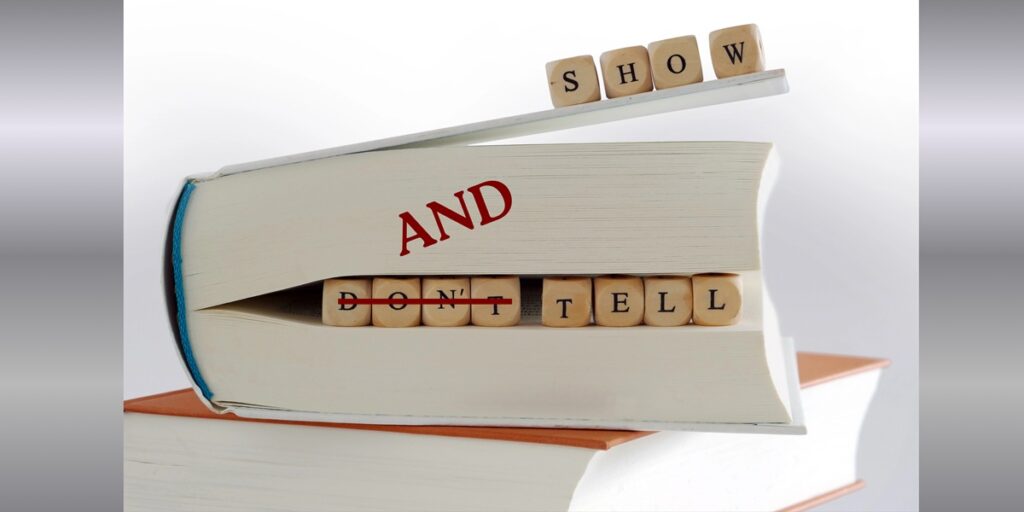
Ask anyone—even a nonwriter—about what good writing entails and they will likely parrot this familiar bromide: “Show, don’t tell!”
Like so many rigid “rules” of writing, this overly vaunted advice isn’t wrong—it’s just incomplete.
Black-and-white guidelines like this try to put rules and absolutes on something that cannot be quantified like a math equation. Art doesn’t behave like algebra, with the whole thing balancing out perfectly as long as you plug in the right factors.
Show—the dramatization of the action of a story on the page for readers to “see” firsthand—is indeed central to story. Without it we’re simply reading a news report on what happened, rather than experiencing it along with the characters, which is so much of the immersive magic of story.
But much-maligned “tell”—that expository description of a thing instead of the thing itself—also has its place in good storytelling, in fact an indispensable one.
Understanding where this misguided writing advice comes from—and where it’s useful—can help a writer decide where each one serves their story and where it may hamper it.
Show Brings Story to Life
Show is beloved in writing because it’s a tool to bridge the gap between the writer’s imagination and the reader’s. In a medium where words are our only pigments, we must paint vivid, visual pictures if we want our stories to come to life.
“Tell me something about your mother,” Patrick directs his niece and nephew in the opening scene of Steven Rowley’s Thurber Prize–winning novel The Guncle.
“She was tall,” offers his niece.
Patrick scoffs.
“She was strong,” ventures his nephew.
Patrick gives up, exasperated. “You kids are terrible at telling stories.”
Patrick has lost his best friend; her children have lost their mother. He doesn’t want to hear descriptions of her traits. He misses his confidante and companion, and dry detail isn’t going to bring her to life the way he longs to resurrect her.
This is why “show, don’t tell” came into primacy: As Patrick says, “tell” is terrible storytelling when you’re trying to evoke a personality, a scene, a world. It’s an inadequate tool for the job, frustratingly flat and distant—as he proceeds to demonstrate for his young relatives:
“Our friendship began in darkness. Your mom asked if I wanted to see the view from the roof of our college dorm and I did. We took the elevator to the ninth floor and then inched up a final, musty stairwell, the fire door slamming shut. Your mom led. She was inclined to do that. I followed, huddled tightly to her as if we were a duo of teen detectives about to uncover some ghastly twist in our case….”
He goes on, “teaching you two how to tell a story,” as he archly says to them. But what he’s really doing—for himself, for the kids, and for us—is making her real, letting them “see” her and who she was and what she was like and the texture of their close friendship and what she meant to him.
And what Rowley is doing is giving readers reason to care about this dead character we will never meet, and to understand the magnitude and impact of her loss on the people who loved her. He is setting up the foundation of his story without which it won’t mean enough to readers to entice us to read on. Of course he must show it—how else could he engage our emotions?
Read more: “Bring Scenes to Life with Nonverbals”
Tell Conducts the Reader’s Experience
But not every moment in a story calls for that kind of vivid, evocative show. Tell helps direct the “camera” toward the main action, the core meaning, what the story is really about.
In Annika Norlin’s The Colony, buttoned-up loner József encounters Sara, a near stranger, in the fresh acuteness of his grief after his mother has died.
She says nothing: “Instead, she approached him, and held him. For a few seconds it felt strange; his body resisted, he didn’t want to be held. Then he gave in, and fell into the hug. And he noticed his body starting to jump and wriggle again, but she stood firm, she stood strong. She held him like a pillar. He opened his mouth and wept. And he wept and wept, and she stayed there. She stayed there until his body calmed down. For maybe ten minutes, they stood like that.”
The scene is “show” in the sense that we’re seeing it play out before our eyes, but the emotion is “tell.” That’s far more effective for Norlin’s intentions in this scene: It’s about the powerful connection Sara and József are developing, one that becomes central to the how the rest of the story plays out.
Plunging readers directly into József’s grief would risk melodrama and pull focus from what the scene is really about. His feelings for his mother are not the fulcrum of the story or his arc; his feelings for Sara are. Norlin describes the manifestation of his terrible grief, while dramatizing the potency of Sara’s singular ability to hold not only him but his pain in this moment.
Show *and* Tell
There are other times tell is the right brush for the job. With logistics, minor details, connective tissue between scenes, and other information readers need that isn’t central to the story or character arc, tell is often far more efficient and expedient. Imagine the tedium of playing out every single pedestrian moment in a character’s life; move the story forward and skip to the meat.
Authors—especially those in genres like fantasy or sci-fi or historical fiction—sometimes get lost in the “show don’t tell” edict in painstakingly trying to paint a vivid picture of the setting of their story or share meticulous details from their exhaustive research, when a few well-chosen specific details peppered into the forward movement of a scene would allow readers to fill in the rest without stalling momentum.
Not everything needs to be dramatized—if you do, you’re likely to bog down readers in minutiae: Inflicting on us a moment-by-moment transcription of every moment of a character’s life, instead of—as Elmore Leonard advises—leaving out the parts people tend to skip.
But skim over essential parts of the story in dry expositive “tell” and you leave readers at a remove, passive bystanders watching the story unfold before us but left out of the action ourselves, and therefore unaffected by it. It’s the difference between hearing a story on the news and being there experiencing it firsthand. You may find something intellectually affecting, but you aren’t feeling it.
That’s the power of story: It gives readers experiences we may not actually have had. It lets us live other realities as if they are our own—not through telling us about a character’s life, but allowing us to live it along with them.
And yes, often that entails plunging us directly into the action with vivid, vibrant, immediate “show.” But that’s only part of the picture, and completing it with informative, expedient “tell” helps fill in the rest. (After all, it’s called storytelling.)
If you want to dive deeper into these two useful tools for bringing story fully to life, join me and Jane Friedman Wednesday, May 27, at 1pm ST (recording avail) for my brand-new course, “Showing and Telling.” With plenty of examples, we’ll look at why each of these tools is essential to good storytelling; how to determine when to use show most effectively and when to use tell; and how they often work together.
Authors, do you subscribe to the “show, don’t tell” edict? How do you determine which parts of your story would be more immediate or vivid in show, and where to use tell to keep things moving?
If you’d like to receive my blog in your in-box each week, click here.
FoxPrint Editorial helps writers strengthen their manuscripts through developmental editing, education, and practical writing guidance. Explore more articles on revision, storytelling, and the publishing process.
10 Comments. Leave new
Thank you for this. Different definitions of, and lines drawn on Show, Don’t Tell are why I am extremely careful about choosing Beta Readers and Editors.
And every reader is different regarding how they respond to a story. It does help to find beta readers who are representative of our target readers. Thanks for the comment, Teri!
Tiffany, this is terrific. Having pivoted from biographies to write a historical fiction, I’m struggling with show and tell. It’s refreshing to show, and be able to make up conversation and feelings (after all, my characters are fictitious!). But there are times where you MUST tell to, as you say, move the story forward. I’m so glad the book police won’t be coming to arrest me for using both. If they do, I’m giving them YOUR name. LOL
Ha! Send ’em my way; I’ll go toe-to-toe on any policing of writing “rules.” Drives me crazy to see a formula or rigid dogma imposed onto what is so subjective an art. Glad the post hit the right note, Judy.
Thank you very much for your post today, Tiffany. As a novice writer, I tend to get confused between showing and telling in my stories. And since I have little patience, I want to try to push the story forward rather than taking my time to paint the scenes more vividly. I need all the help I can get to better understand this aspect of storytelling. Looking forward to your course later this month!
That’s a pretty common stumble, Jeff–it’s easy to want to dramatize everything so we can live out the worlds of our imagination on the page with our characters. And it’s not always easily evident which technique might serve the story best, where. Like everything in this craft, it’s subjective, and you learn by doing. Thanks for the comment!
Hi Tiffany, great article. After reading this, my thoughts sent me searching for your book, “Intuitive Editing.” It was easily found, with its twenty bright-colored tags sticking out from its pages. I reread Chapter Six titled “Showing and Telling.” Finding a multitude of my highlights, single and double underlines, and margin notes, I am reminded to place your book on my frequent reading list. Within this chapter, your callout box, “A Word about Descriptives,” demanded my margin note: “This I Love!!” I urge any writer interested in going deeper into this topic (and other important writing subjects) to invest in “Intuitive Editing.”
Well, now you have made my day. Thanks, Lawson–it means a lot to know the book is helpful to you in your writing–and I appreciate the shout-out!
We do need show and tell in all stories, but I’ve struggled to show things. I appreciate how you ‘showed’ that telling isn’t all bad if it is active and helping to get the emotions across.
My thing on showing vs telling is know the rules and break them judiciously while not boring the reader. Active telling is never boring.
Agreed–tell used well is as important a tool to keep readers engaged as show is. They’re a tag-team duo. 🙂 Glad the post was helpful!