

If you’d like to receive my blog in your in-box each week, click here.
One of the things I love about living in Austin is that it seems to offer endless opportunities to—for lack of a better term—do cool stuff.
So when a friend who heads up the Texas Immersive Institute, the interactive and immersive media department at the University of Texas here, offered the hubs and me the chance to sit in on a guest lecture by Vicki Dobbs Beck, vice president of Immersive Content Innovation for Lucasfilm and ILM, heck, yeah, I jumped on it.
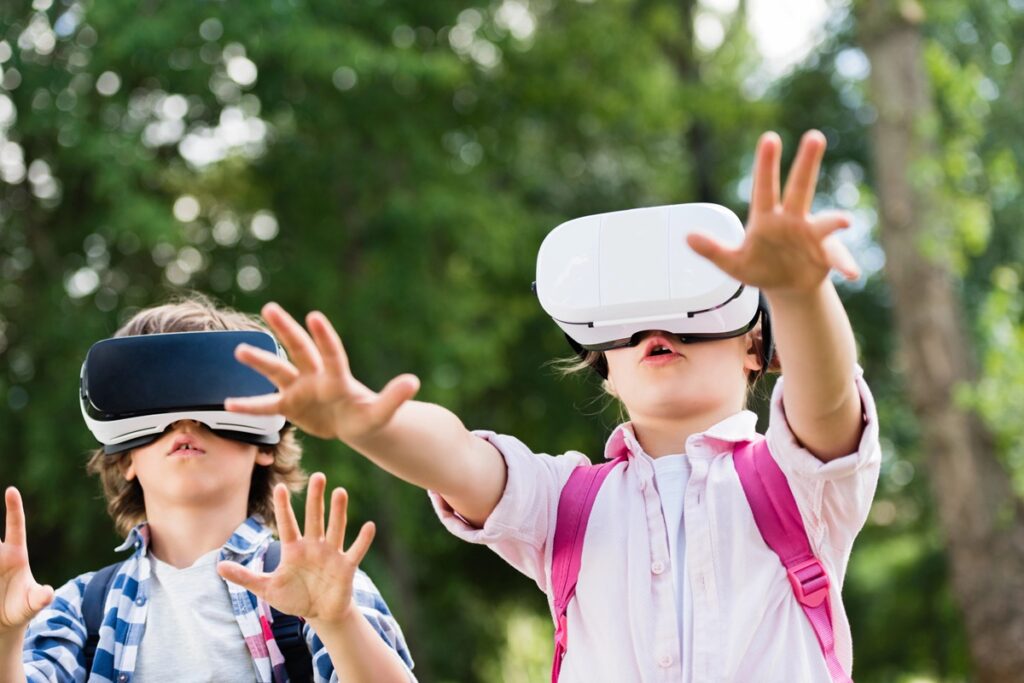
“Immersive content” basically refers to virtual and augmented reality—bringing people actively into a story, letting them be a part of it. With advances in AI I’m interested in what it might mean for our industry, how it could influence storytelling and storytellers.
Let me start with my usual caveat: I’m not especially tech-savvy or even tech-forward, and I’ve never been what anyone would call an early adopter of technological advances. I tend to be dragged forward into an evolving future—but go I do, because the alternative is stagnation in my field, in modern society, and in my personal growth.
I was fortunate to marry my husband—for many reasons, not least being that he is extremely tech-forward and forces me to stay ahead of the technological curve. He refinanced his car in 1987 to buy his first computer, carried one of the early “bag phones” in a satchel he carted with him everywhere in the early nineties, and until not long ago we had an entire room dedicated to housing old, outdated tech. (It’s sentimental, I guess?)
Beck spoke for more than an hour on how Lucasfilm/ILM is working to pioneer immersive storytelling—or what they call “immersive storyLIVING.” And as she showed clips of some of the company’s work that brought story vividly, immediately to life and plunged viewers into it, I was enthralled by the possibilities.
You know how, with favorite stories, the characters seem to come to life? What if they really did? Imagine not just reading (and rereading) your favorite story, but stepping into it, like in the Black Mirror episode where a modern-day actor is “inserted” into a classic black-and-white film and gets to live it.
As Beck showed clips from the 2025 Lilo & Stitch premiere, where Lucasfilm allowed attendees to meet and converse with Stitch in real-time interactions, I was enchanted right along with the kids—and adults!—bantering with this adorable animated character. When they showed the campaign where Stitch crashed into social media influencers’ feeds, engaging directly with them and their followers, I shared their wonder-struck delight. ILM brought ABBA back to their glorious 1970s heyday for concerts! They made KISS avatars!
My head was spinning with the promise of it all. How could we, as written-word storytellers, adapt this kind of technology to allow readers to engage with our characters directly?
Interactive story formats already exist in areas like LitRPG and interactive videogames, web series and digital content, immersive and interactive performances, and a variety of interactive story formats. How might these approaches—and others—allow creators to bring readers right into the stories we create—inviting them right into the rich worlds in our head? How can we utilize, adapt, and innovate beyond these formats? What connection and understanding might that forge between humans that could begin to heal some of the awful divides in our society?
Oh, but then, friends… Then things took a bit of a dark turn.
Blurring the Line of Reality and Fiction
Beck built to what seemed like the climax of her talk and the technology: that in the not-distant future, people could interact in their daily lives with “character companions,” their favorite characters brought to life and always with them, like an imaginary friend but one made of binary code (which I’m assuming they could purchase or subscribe to).
Smart glasses and even “smart contacts” could allow anyone to basically live in a “mixed reality” (MR), and Beck showed video re-creations of people seeing whole scenarios and beings out in the everyday world that don’t actually exist. Screens will be everywhere, she said, showing a slide rendering that reality too.
One slide in particular chilled me: An image of little girl growing up playing hide-and-seek and other games with her “character companion,” BB-8 from the Star Wars universe. These would become part of the memories she’ll always have, Beck said, part of the fabric of her childhood—part of her life.
Except…they’re not, as one student during the Q&A pointed out.
If you’re like me—and I’m guessing many of you are—you probably grew up with favorite stories and characters who lived in your mind, and perhaps still do. Some of the most formative influences in my life have been books, and I’ve learned a lot from reading about fictional characters’ (and real ones, as I’m a big fan of nonfiction as well) journeys. Those are indeed a big part of my memories and development.
Books work this way because they stimulate our imagination. We let them spark ideas, worlds, stories of our own. Story expands, enlightens, and educates us. We extrapolate to our own situations and bring what we learn, the insights we gain, into our daily lives and relationships.
But what does it mean when a child grows up believing that these coded creations are real? When they become a major part of kids’ socialization and growth?
If we’re addicted to screens now, what happens when they are everywhere, when we have “character companions” Beck says people can “collect,” rather than face-to-face engagements with people? What happens when we live more in these artificial constructs than we do the real world?
The hubs and I discussed these ideas after the lecture. Many technological advances have faced blowback and doomsday scenarios, he reminded me, and I know that’s true. Memorably, in a recent podcast interview reexamining the attention crisis, I heard historian Daniel Immerwahr talk about the end-of-human-society predictions that greeted other inventions, like the piano and the stove.
But when reality becomes integrated with fiction, how will we tell the difference?
When reality becomes integrated with fiction, how will we tell the difference?
Beck talked about a few employees recusing themselves from working on the horror arm of their “storyliving” developments because it was “too visceral” for them.
Extrapolate this tech to integrating that into daily life with AR/MR headsets: What happens to a mind immersed in that kind of horror? Is it so different to see—or cause—“visceral horror” among the “people” who seem to surround you in your daily life that are computer-generated fictions, versus the ones who are flesh-and-blood humans? And what happens to your mind, your sanity—your moral judgment? What happens to your sense of humanity, your respect for it?
I think so much these days about the distance between people, the polarization; I think about the “loneliness epidemic” people seem to be feeling, and the growing mental health issues, many already attributed, at least in part, to the isolation and altered reality of tech advances like the internet, social media, AI.
I always think story is one of the most powerful tools to battle these crises: Story connects us, humanizes us, brings into our conscience people, cultures, worlds, situations that may not be like ours and lets us “de-otherize” people we may not understand through characters we relate to, invest in, care about. It brings us closer together.
But what happens if you never have to exit those stories to bring that perspective and understanding into your everyday world and real-life interactions? When “living in your imagination,” as so many of us creatives especially have been accused of doing, means you never have to come out of it and interact with reality? When you can live as much as you choose to in an artificial world that doesn’t actually exist, interact with it and imaginary friends, and believe it’s truth?
So What Can Creatives Do?
I try not to be alarmist. I’m a realist, and I understand the horse is out of the barn.
In answer to the student’s question I mentioned above about the implications of a child growing up in an artificial “reality,” Dobbs said that with great power comes great responsibility, and that she’s “bullish” on AI when it’s used for good.
That sounds palatable and practical—and I’m all aboard for the potential positives of this kind of technology. But who is to determine what “the good” is?
A question my husband wanted to ask but didn’t get the chance: Does Lucasfilm/ILM have an internal ethics board that considers that, regulates it? Do any of the companies developing this kind of tech?
And what weight would their advice carry even if so, weighed against the Holy Dollar? Because all I could think during the second half of the presentation was that these creations weren’t meant to aid and further humanity, but to create profit, as Beck suggested in her opening in relating the company’s “blue ocean” approach “to carve out new and uncontested market space.”
And when that becomes a company’s highest “good,” then what impact or meaning does an internal conscience board have? We’ve seen what happens with that already, with AI companies and social media seeming to disregard impact considerations, and our current administration ignoring or neutering ethical oversight and regulating bodies like the Office of Government Ethics or Fannie Mae’s ethics and internal investigations unit, in the seeming focus on profit and power above all other considerations.
These thoughts kept me up the night of the lecture (and several nights since). But living in fear is no life at all, as I talked about in last week’s post; we have to acknowledge it and act anyway.
So what can authors do?
- Stay informed. For starters, we have to be aware of what’s happening in our business and how these advances affect it; ignoring changes and hoping they won’t impact us is no strategy at all. I’ve managed to keep working in my field over many decades of profound changes in our industry by staying informed about what’s happening within it and adapting my business to keep up with those changes. (Publishing expert Jane Friedman is one of the best sources of up-to-the-minute information and analysis about the publishing industry I know of, and her paid newsletter, the Bottom Line, is an excellent resource for staying informed.)
- Protect yourself. As we’ve seen in recent headlines, given the lack of meaningful regulation over AI LLMs and the growing free rein tech giants seem to have to “innovate” without regard for potential harmful fallout, there aren’t a lot of guardrails or protections for creators at the moment, so it’s up to you to safeguard your IP as much as possible.
- Adapt. As I suggested in the first section of this post, I think there’s positive potential in how evolving technologies and markets could impact our business and our creative work. A few weeks ago I wrote about author Jaysea Lynn, who launched her writing career with a series of TikTok videos about a help desk in hell, creating a world and characters that resonated so deeply with viewers that she started writing about them too in installments she shared on her Patreon page, and then self-published to about 40K preorders before garnering a major two-book deal with a traditional publishing house. Authors have more options and opportunities and access to reach readers than ever before. Think outside the traditional paths and be open to investigating them. Innovate and explore—it’s what keeps us alive and growing, rather than stuck and stagnating.
- Create. I remain convinced that despite the fact that anyone can now generate a story with a prompt and a click, quality human-created stories will always find a market. And even more than that: I remain convinced that creating them—the old-fashioned way, with imagination and effort and our individual and unique selves—is foundational not just to our creativity, but our humanity. Don’t let the noise and confusion and fear smother your Muse. Don’t let it rob you of the joy and meaning of what we do.
I try not to be a Luddite decrying the end of civilization with every technological advance. I’m aware that life and society mean constant change, constant evolution, and that’s not necessarily a bad thing. As with most other developments, none of these developments is inherently good or bad; it’s all in how we use them.
I genuinely see a lot of excitement and promise in some of these new technologies. And I also see the need for caution and care and how we deploy them, and in considering the impact they might have on individuals and society.
Let me hear it, authors! Are you using advances in technology and other innovations in out-of-the-box ways to share your work or reach readers? How can we adapt some of these immersive storytelling techniques to serve and expand our stories and our writing? What other considerations have I not factored into my equation here?
If you’d like to receive my blog in your in-box each week, click here.
7 Comments. Leave new
My deepest concerns have nothing to do with the technology. What changes everything—a point you touched on—are ethics and regulations.
What happens to children who grow up with friends who do exactly what they want? What, exactly, are those little friends saying to your child? Is there bias buried in their words? Are we talking about a Big Brother that goes everywhere with you?
People might tell me that I’m just scared of new tech. I’m not. I’m terrified of those who make and control it.
“I am the great and powerful OZ.” Remember that? 1939. Imagine that imposing head and voice as the new tech coming our way. Now, remember that there was a man behind the curtain controlling it. That’s my issue.
Anything that has a Bluetooth connection has a connection to someone else. Never lose track of that fact. Once someone has access, their ethics end where their greed begins. This has been proven every day of 2025.
Last week, my blog stats soared. WP told me it was all different people who all just happened to be reading different posts (but NOT any of the poetry). All these people just happened to be taking turns, each waiting for the other to read the next post.
That’s called deceit.
So, I waited, knowing what was coming. The reader explosion ended. A few days later, I received an email from the person behind the curtain who’d analyzed my posts to gain insight into my first book. They offered me marketing opportunities. it read like AI, of course.
Oh the irony. Their deceptions embodied everything my characters are opposing.
Perfectly stated, thank you: “I’m terrified of those who make and control it.”
As well we should all be. Their aim is certainly not to help us, but to create more of themselves through us: shallow, sociopathic freaks who lack any true imagination. It’s all bullshit.
I thought about that too, Christina–that these aren’t human interactions, but rather (I’m supposing) the kinds of “conversations” we have with AI now: the illusion of connection. That’s what disturbs me most about the idea of “character companions” and XR–that it will impact our ability to form real social connections and learn interpersonal skills that are so necessary to navigate life.
And oh, yes, those AI solicitations are growing ubiquitous. I’m always amazed at how much effort and ingenuity people will put into creating scams. I wonder what they might accomplish if they brought that same skill and dedication to something legitimate…?
Thank you for your stimulating and insightful post, as always. My father used to say “Be not the first to try the new untried, nor yet the last to set the old aside.” As a scientist and engineer, I have always venerated technology, thinking that it will help us build a better life for everyone. But it’s a bit like wearing eyeglasses. You have trouble seeing as well as you did when you were ten years old, so you go to the optometrist and get an eyeglass prescription. Hurray, you can see better with the glasses on. But over time you need to go back to the doc for a stronger prescription and when you take the glasses off, your vision is much worse years later; you’re dependent on the technology. I think most tech is the same way. I do fiber optic communication and it really helps tie us together with Zoom and downloadable movies. But it also gives us the illusion that we can move thousands of miles apart from one another with little consequence. So, does it help us stay connected or allow us to move apart from one another, become more isolated?
I think immersive content is the same way. It can be a wonderful experience, but it allows us to exist in isolation, socially. That’s bad. I believe your thoughts about managing the tech are right on target. Unfortunately, not everyone can do that, so it offers an opportunity for unscrupulous people to disseminate horrible propaganda. I think we see that in politics every day.
Frank Marlow published a fascinating book called Hadza: Hunter Gatherers of Tanzania. These folks have almost no tech at all and live as people lived 60,000 years ago. But their society is one of the most closely knit and happiest in the world. Something to think about.
I like your dad’s saying (and his caution!). That’s me, firmly in the middle of the bell curve. 🙂
I think the isolation you mention is what concerns me most. It’s a cliche, but true: It’s so easy to bury ourselves in our screens now and not connect with others. How much worse might that be when we’re each living our own private “reality” with these XR technologies–not only not needing to engage with other people, but not even sharing the same world, each person in the one of their own creation? I love imagination and I’m all for it–but I think that real human connection, community, and society are the backbone of civilization, and ours are already fraying.
My hubs jokes that I’m Amish because I resist technology (at first…and then I grudgingly adopt it)–but like you, there’s something lovely to me about the idea of just interacting with people in a simpler, more direct way. I know I’d miss all my tech if I lost it–it’s what makes my business possible, for starters, amid many other benefits I wouldn’t want to sacrifice. But I do hope we find a way to maintain the social connections amid all these advances and find community. Thanks for the comment, Jeff.
What would Darwin think?
I think he might be plenty baffled by our evolution at this point. 😉