


If you’d like to receive my blog in your in-box each week, click here.
Friends, have I ever told you any of my audition stories from when I was an actor?
Auditioning is hard, and in the many years as I worked as an actor—which means I had hundreds and hundreds of auditions—it never got any easier.
I became intimately familiar with painful face-to-face rejection: when a producer or director stops you in the middle of a scene you have spent hours working on with a curt, “Thanks” or “Next”; or doesn’t even look up from their script or notes at all to pay attention to you; or offers casually cutting feedback on your performance or (too often) your person: you’re too old, too tall, “more of a character actor” (code for “not pretty enough”).
The hardest auditions were also the most common: giving a monologue by yourself standing on the stage (or worse, in some sterile office or conference room) speaking to only an imaginary partner, or staring into a camera, or performing a scene while a casting assistant with absolutely no experience in nor interest in acting reads the other character’s lines in a monotone.
The auditions I actually enjoyed were when I got to do scenes (or “sides”) with another actor who was fully engaged in the scene with me. But there’s a saying about showbiz: Acting is reacting. The actors who didn’t embody this truism were the ones every actor most dreaded auditioning with. They came to life only on their own lines, and during the rest of the scene it was like trying to interact with a dead stick, no better than the solo auditions or the ones with a deadpan assistant.
Acting is indeed reacting—but most of human life is too: not just our own reactions, but those of whoever we’re interacting with. We don’t exist in a vacuum; we’re recalibrating every micromoment based on the input we get from other people: their behavior and reactions that indicate what’s going on inside them and affect our own actions, behaviors, and reactions.
And like the dead-stick actors, if authors fail to show that symbiotic relationship on the page, their scenes and stories can feel flat, lifeless, and fail to engage readers.
I see this fairly often in stories I’m working on—even with experienced writers. An author may be diligent and thorough about letting readers be privy to the main or POV characters’ inner lives, but can sometimes fail to consider the other half of the equation: how the other characters in the scene are reacting—and how those reactions in turn impact each character, the action, and the scene.
It’s Feelings that Matter, Not Just Facts
When I’m engaging with people, I tend to be hyperattuned to nearly every nuance of the “nonverbals” of our communication, observing them almost as closely and steadily I do my reactive dog, Gavin, to ensure I’m aware of his inner state (before he decides to go full-on Night Fury or Tasmanian devil).
This might be because I’m fascinated by people and what makes them behave as they do (which I am) or because I savor connections on a genuine and intimate level (I do); but it could as easily be because I want to be liked and so I am often monitoring people’s reactions to see whether they’re on board with me and our interaction. In any case, the result is that I tend to pick up on a lot of subtle cues and nuances that give me an idea of what’s going on inside someone else.
On the flip side, my extremely introverted husband will report conversations he has with people that go like this:
- Me: How is so-and-so? [We’ll call him Pickleball Pal for specificity, since that’s who most of his social engagements are with these days]
- Hubs: Fine. His daughter is getting married and he says he’s got mixed feelings.
- Me: Why? About what?
- Hubs: I don’t know. I didn’t ask.
- Me: Well, how did he say it?
- Hubs: “My daughter is getting married and I have mixed feelings.”
- Me: [restraining myself from rolling my eyes, as I know this is a reaction guaranteed to elicit annoyance from the hubs—see these complex character interactions at work?] But how did he seem?
- Hubs: Um…present? Sweaty? I don’t know. It was between games.
My husband isn’t focused on these underlying nuances—especially when he’s intent on playing pickleball. He tends to take conversations at face value and will often remember exactly what was said.
I, on the other hand, often forget the details of a conversation, but how it went and the other person’s affect, demeanor, and expressed emotional state will stick with me. I’ll remember a friend is upset about their child’s upcoming nuptials, and generally why—they think their spouse-to-be is waving red flags about ambition, honesty, and empathy for their kid, let’s say, because of specific actions/behaviors I will also clearly recall—but I may not remember the fiancé’s name, or when the wedding is supposed to be.
Stories aren’t primarily about the facts; they’re about the feelings—not just your characters’ emotions, but all of their inner life: what they make of what’s happening over the course of the story and how it affects them, makes them react, and influences their subsequent actions, behavior, and attitudes.
It’s even the same with identifying actors—I may not know what I saw them in before or what specific role they played, but I always know how I felt about them/their character and why.
Neither of these ways of interacting with people is right or wrong—but for writers, being deeply tuned in to others can be a powerful way to bring that same skill to your stories and characters and enhance their impact on readers and the reader’s engagement.
That’s because stories aren’t primarily about the facts; they’re about the feelings—not just your characters’ emotions, but all of their inner life: what they make of what’s happening over the course of the story and how it affects them, makes them react, and influences their subsequent actions, behavior, and attitudes. That’s how you move the story forward, and how you develop the character arcs and show them moving along it—and much of that hinges on what other characters do and say and how that affects your protagonist.
Interpreting Other Characters’ Inner Lives
Another reason authors sometimes struggle to fully convey the nuance and depth of a scene is because of POV considerations: If the narrative perspective lies within a single character—as with all of the main four POVs except omniscient (first, deep third, limited third)—then how do you organically indicate what’s going on inside other characters without breaching POV boundaries?
Read more: “How POV Affects Character Inner Life”
The same way we do in real life, where our perspective is always limited to our own: through context cues. What are your characters seeing and picking up on that might indicate what someone else is thinking or feeling, what they make of something you’ve said or done or what’s happening or what they’re telling the protagonist or how it affects them?
Most creatives already tend to be people watchers—but go further, deeper. Study psychology; learn body-language cues; read about diplomacy and interrogation tactics, so often based on subtexts, undercurrents, and nonverbals.
See if you can identify the dynamics between strangers based solely on what you see and hear. I once created a whole mental picture of an older couple’s marriage walking down a jetway behind them without ever seeing their faces: The woman kept up a nonstop monologue in her spouse’s ear commenting disparagingly about everything from the gate agent to the airline to the ads lining the walls of the jetway while the man stared straight ahead and only grunted in occasional response.
In your own interactions, notice what people’s behaviors, demeanor, affect, expressions, tone, etc., tell you about what’s going on inside them, and how, in turn, that affects you and your own responses and dictates the tenor of the conversation and your state of mind.
Read more: “How to Let Readers into Your Characters’ Inner Life”
For instance: Imagine asking your boss for a raise. You’ve undoubtedly prepared and practiced what you’ll say and how—but it’s all going to be affected by how you’re feeling in that moment: Whether you’re nervous, how you feel about the boss, your relationship and history with her, your opinion of your own merit, and countless other factors—in other words, your own inner life.
But it’s also going to be affected moment to moment by what actually happens in your interaction: the myriad subtle (or not so subtle) cues you pick up on as you make your case.
Does she welcome you into her office, leaning back in her chair and gesturing you to cop a squat as if you’re old pals catching up for a chat? Greet you at the door with a formal handshake and a crisp, “What can I do for you?” Barely acknowledge when you walk into the room, intent on whatever she’s working on? All of those reactions are going to affect your own inner state—and thus your own reactions—as is every other beat of the entire exchange.
This is a single high-emotion example, but this kind of constant barometric variation and recalibration is happening pretty much every moment of every human interaction you ever have. One of the most effective ways to master the art of creating vivid, substantive, affecting scenes is by learning to pay close attention to how much other people’s actions and reactions are impacting your own—and your entire interaction—and then practice putting that kind of depth and nuance on the page.
Read more: “The Trick to Writing Compelling Inner Life”
Observe not just the other people you engage with, and not merely your own reactions, but the complex dance between the two, and how it’s shaping your interaction in every single moment:
Maybe you’re in the middle of a particularly good writing session, happily lost in flow, when the front door bursts open and yanks you out of it, momentarily startled and perhaps fearful, before you see it’s your teenage son and a flare of annoyance replaces those reactions.
You castigate him for banging the door against the wall before you notice he’s clearly upset about something—your stomach tightens when his stricken face hardens and goes opaque. “Nice to see you too,” he snaps, just as you ask in concern, “What’s wrong?”
“Nothing,” comes the flat reply as he brushes past you and beelines down the hall. “Forget it.”
Your heart sinks at the lost opportunity to connect with and comfort your child—you know better than to follow him to his room because of past reactions when you’ve done so, so you decide to make his favorite meal and broach it over dinner.
You go back to your WIP but your concentration is broken, and the rest of your afternoon is colored by your lingering reactions to the interaction: how it affects your state of mind, your actions, and your subsequent behavior. Perhaps you worry about your child or your relationship with him, feel guilty for barking at him rather than greeting him, vow to be more patient, start thinking about meal planning, stew in regret or irritation for losing your productive writing session, etc.
The tenor of everything that follows is dictated by not just the action of your exchange with your son—the facts—but by all the attendant feelings and reactions and thoughts, yours and his, brought on by how each of you interpreted and was affected by the responses and reactions of the other.
The more you practice identifying these subtleties and layers in life, the deeper and more connected your relationships and interactions are likely to become—and the better you’ll get at considering how they affect and enhance your stories, and translating those nuances to the page.
Authors, how do you consider what’s going on inside all your characters when writing–and how do you put that on the page? What do you struggle with when conveying non-POV character reactions and inner life, and creating depth and nuance in character interactions? And how do you use your own reactions in your relationships and interactions as a tool to observe and create these dynamics in your stories?
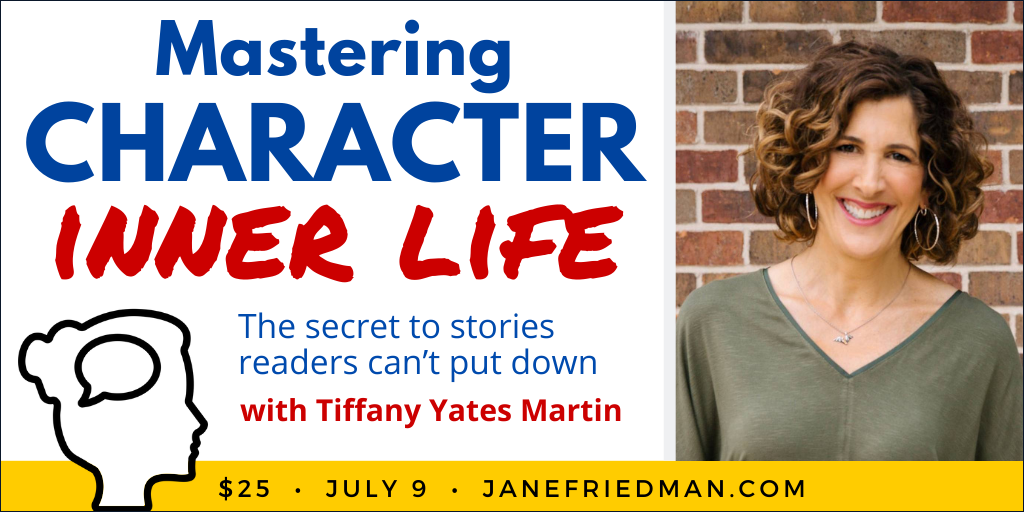
If you want to dig deeper into developing and deepening character interiority, join me with Jane Friedman for my brand-new course, “Mastering Character Inner Life” this coming Weds., July 9, at 1 p.m. ET ($25, with video playback for registrants). Full list of what you’ll learn and what supplemental materials you’ll receive here.
If you’d like to receive my blog in your in-box each week, click here.
10 Comments. Leave new
Once again I am amazed at your clarity and depth of thought about writing and character development. I am trying to learn as much as I can from you. But I am an engineer/scientist and I am frustrated by the advice that I can’t go outside the main character’s POV, “no head hopping.” What if the main character is elsewhere and there is an essential scene that is needed for the story to make sense? I am tempted to abandon the MFA playbook and write what I want. No one is going to read my stories anyway. Your advice would be most helpful.
Once again, Jeff, I’m grateful for your kind words. 🙂
First off, please don’t tell yourself no one will read your stories (unless you don’t intend to share them, that is). We don’t know what may happen with our work and our careers, but I think it’s important that we always be our own champion of it–and of ourselves. Your work is worth sharing, and reading.
To your question–I’m not a big fan of rigid “rules,” as you may know, but POV is probably among the more important elements of craft to master and use well; it’s crucial for orienting readers to your story and providing an immersive, engaging, and seamless reading experience. So with that said, I do recommend digging into the topic as much as you can to really internalize the concepts and parameters of POV, and what can be confusing or jarring for readers. In your example, you could simply have other sections written from a different narrative perspective, which is often done in stories–but how you do it matters. If it feels like a one-off or “cheat” or narrative device, you risk losing the reader. Like everything else, it needs to be seamlessly woven in to fluidly orchestrate the reader’s experience. And it’s hard to gauge how well you’re doing that without seeing it (this is where beta readers/crit partners can be invaluable.)
It can help to ask yourself, if you’re telling this story in a direct POV, why you need readers to know more than your character (which is the effect of what you’re describing). Would it still convey the story you envision if you keep readers fully immersed in the character’s direct POV, sharing their blind spots, and living along with them how that affects their actions, attitude, behaviors?
Hope that’s helpful. You might also read some of the posts I’ve linked to in this post, which also cover POV (and there are more links in the one on Jane Friedman’s site about inner life and POV).
Thank you Tiffany. That is extremely helpful. I think I know now what I have to do to fix my story!
Good luck with it, Jeff!
Wow. This is very helpful and clear. I’m editing my memoir and will work on identifying and adding these subtle actions/reactions. Thank you!
Thanks, Leslie–I’m glad it’s useful!
For all that I do this, and have learned to do this, I’ve never set down my process in any formal sense. It’s another case of process baked into my brain so I can utilize it, yet I struggle to explain it. That’s how I went from struggling to pass English when learning it, to Honors English when applying it.
Wow, that was a shock! 🤣
For each character, right down to side characters, I know varying amounts about them, sometimes a considerable amount. I also think of each character as having a little piece of me in them. It helps me relate. Too, I head-hop (literally in my head, but never on the page). It just kinda happens.
Even though each chapter is in a particular character’s POV, my mind switches to the other character when they speak or there are non-verbals. Except, that’s also through the filter of the POV character. It’s kinda tricky, and I’m always worried about doing too much or not enough.
So much depends on the character’s importance in the story, or in the scene, what’s happening, and the state of the emotional/physical dynamics occurring. When it comes to drawing upon myself, that’s limited, though I do try to “method act” to a degree.
It feels like my answer here is jumbled as my answers often are when having to make concrete what’s fluid in my mind.
Girl, you are speaking my language–I am often facing that hurdle of taking what I have learned and know and articulating it. That’s one of the challenges of teaching and writing about writing–but what I love about it is that it also forces me to deeply think about these ideas and theories and techniques and concretely put them into practical, actionable, understandable terms, which deepens and enhances my own understanding as well.
I share your inclination to put yourself inside each character’s head to some degree–that helps me flesh out my characters and scenes when I’m writing fiction too. I suspect it’s a remnant of my acting days (or maybe just my people-monitoring tendencies where I’m constantly trying to interpret their inner life).
And yes, finding the balance is hard–that’s where outside eyes come in handy. It’s so easy to misgauge how well we’ve conveyed the full depth and nuances of the scene and character interactions when it’s usually so vivid in our own minds–we need objective eyes to help us see what’s actually on the page. Thanks for sharing, Christina!
Thank you for this extremely informative piece about revealing the inner lives of various characters in our stories.
As a codependent person, I’ve spent much of my life being more attuned to the feelings of others than to my own. By studying social work and psychology (and practicing the latter for 34 years), I have developed empathy to an art form. I try to show on the page, via narration, dialogue, and body language, the feelings and reactions of the main characters in my books.
I’m struggling a bit with conveying the impact of interactions on main characters, showing what meaning conversations or behaviors of other folks have on them. But this article gives me lots of suggestions I hope to digest!
Well, at least you’ve found an upside of being codependent…especially for a fiction writer. 🙂 Between that and your study of psychology/social work, I’m betting you have a deep reservoir of emotional/mental understanding and insight to draw from in creating your characters’ inner lives.
The exercise I think I mentioned about observing your own reactions in interactions with others may be helpful in shedding some light on how to convey the effect and impact of their inner lives (as interpreted by your protag) on your characters. We’re constantly calibrating to others’ reactions and what we interpret from them.
Thanks for sharing, Lee–I’m glad to hear the post was helpful.